Contents
- 05 Aug 2026
Generative AI in Analytics: What It Actually Does, and How to Deploy It Well
Generative AI in analytics has moved from experimental to production across enterprise data environments. Gartner projects 40% of analytics queries will use natural language querying (NLQ) by 2026 [Gartner]. Organizations with structured data governance achieve a median ROI of 347%; 95% of ungoverned pilots fail [SR Analytics]. DataTerrain builds the governed data foundations that make AI-powered analytics deployments accurate rather than confidently wrong.

- Share Post:
-

-

Generative AI in Analytics: What Does It Actually Cover?
| Capability | Business Benefit | Example Tool | Keyword |
|---|---|---|---|
| Natural Language Querying | Ask questions in plain English; no SQL required | Power BI Copilot | Conversational analytics |
| Automated Insights | AI-generated narrative summaries and anomaly detection | Tableau Pulse | AI insights |
| Agentic Workflows | End-to-end automation: detect, analyse, report, distribute | Snowflake Cortex AI | Analytics automation |
| RAG Architecture | Grounds LLM outputs in enterprise data; reduces hallucinations | Databricks AI | LLM analytics |
| Report Generation | Executive-ready AI reporting from natural language description | Alteryx AI | AI reporting |
| Self-Service Analytics | Business users explore data without analyst involvement | ThoughtSpot Sage | Enterprise AI |
What Is Generative AI in Analytics and Why Does It Matter Right Now?
Generative AI in analytics applies large language models (LLMs) to data tasks: writing SQL from plain English, generating narrative summaries, detecting anomalies, and executing autonomous multi-step workflows. Unlike traditional analytics, which returns errors on bad data, generative AI returns confident-sounding outputs regardless of data quality: making the data foundation the primary deployment success factor.
What Real Benefits Are Organizations Seeing from Generative AI in Analytics?
- Faster reporting: AI-generated reports replace hours of manual assembly, with organizations reporting 50 - 70% reductions in reporting cycle time.
- Self-service analytics: Business users get visualizations in plain English without having to route requests through analysts.
- Better executive reporting: Automated narratives deliver executive summaries from live data daily.
- Reduced analyst workload: Routine recurring queries - 80% of most analytics request queues - are automated, freeing analysts for interpretation and strategic work.
- Better decision-making: Organization-wide decision quality improves when all users access governed AI-interpreted data.
What Are the Three Core Capabilities You Need to Understand?
Generative AI adds three distinct capabilities to enterprise analytics environments that traditional BI platforms do not provide natively.
1. Natural Language Querying (NLQ)
Natural language querying (NLQ) allows business users to ask questions in plain English and receive analytical answers without writing SQL or navigating a BI tool. A finance analyst types a question in plain English and receives a visualization with an AI-generated explanation.
Conversational analytics through NLQ democratizes data access for the 80% of users who cannot write SQL. Output quality depends on the semantic layer: a governed layer produces accurate answers; an undocumented warehouse produces hallucinations.
2. Automated Insight Generation
Automated insight generation scans datasets proactively, detects anomalies, and generates narrative explanations without manual prompting. Tableau Pulse's proactive metric monitoring and Power BI Copilot's automated narratives both implement this capability, shifting analyst effort from report assembly to validation.
3. Agentic Workflows
Agentic workflows are multi-step analytical processes executed autonomously by an AI agent, with no human intervention at any step. An agentic analytics system might detect a revenue anomaly, query the relevant data sources to identify the contributing factors, generate a narrative explanation with recommended actions, format it for the relevant audience, and distribute it through email or Slack: all triggered by a single scheduled event.
Analytics automation through agentic workflows is the primary enterprise AI investment in 2026. PwC's 2026 AI Business Predictions report confirms this shift, with organizations moving away from isolated AI chatbots toward agents that automate multi-step analytical processes end-to-end. The architecture requirement for agentic workflows is a governed, well-documented data environment with clear access controls, because agents operating on poorly governed data produce errors that propagate across the entire automated chain before any human reviews the output.
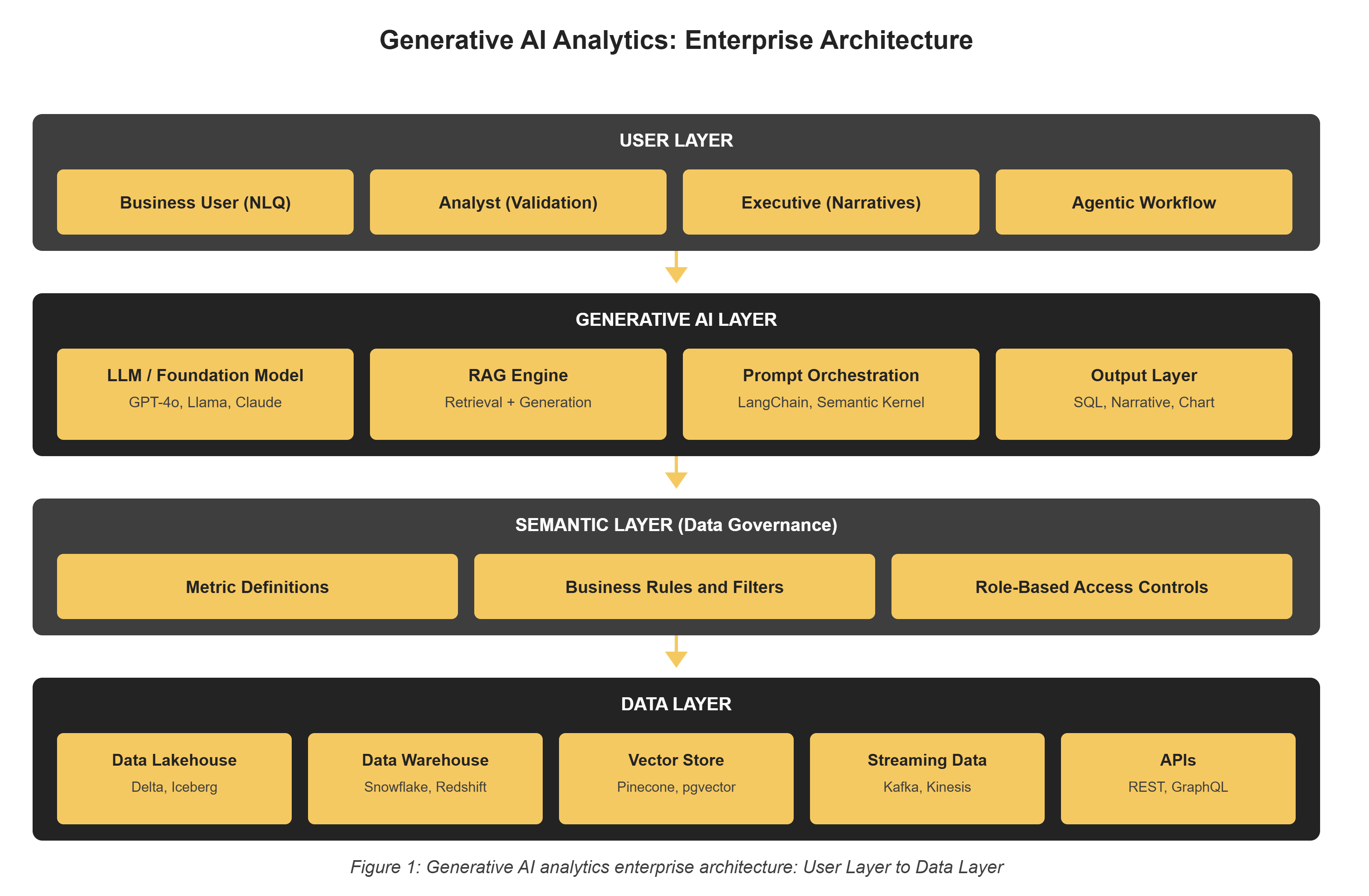
How Does Generative AI Analytics Actually Work Under the Hood?
The standard architecture uses RAG (Retrieval-Augmented Generation) to ground LLM responses in enterprise data, reducing hallucinations. The semantic layer is the most critical component: it defines business metrics the LLM can reason about accurately. Without it, the LLM interprets raw column names inconsistently.
Which Generative AI Analytics Tools Are Leading the Market in 2026?
The major AI analytics platform options each implement AI-powered analytics in different ways. The right choice depends on your existing data platform, team skills, and deployment model. According to Databricks' 2026 State of Data and AI Report, 60% of enterprises now use more than one AI analytics tool, reflecting the reality that no single platform dominates every use case.
| Tool | Best for | AI Features | Strength | Weakness | Deployment |
|---|---|---|---|---|---|
| Power BI Copilot | Microsoft / Azure orgs | NLQ, DAX generation, automated narratives, report creation | Best Fabric integration | Azure only | Cloud (Azure) |
| Tableau Agent / Pulse | Salesforce ecosystem | Autonomous exploration, proactive metric monitoring, AI visualizations | Strongest visualization | Higher per-user pricing | Cloud/ hybrid |
| Snowflake Cortex AI | Snowflake data cloud | Cortex Analyst NLQ, text analytics, sentiment analysis | Multi-cloud, no data copy | Snowflake only | Cloud (multi) |
| ThoughtSpot Sage | Governed NLQ priority | NLQ against governed semantic layer with full drill-down | Best governed NLQ | Narrower scope | Cloud/ SaaS |
| Databricks AI | ML/data engineering | Open-source LLM, RAG on Delta Lake, ML pipelines | Most flexible, OSS | Needs ML skills | Cloud/ hybrid |
How Do You Choose the Right AI Analytics Platform for Your Organization?
The right AI analytics platform depends on your existing data stack.
| If Your Organization Uses | Best AI Analytics Platform | Why |
|---|---|---|
| Microsoft Azure / Microsoft 365 | Power BI Copilot | Native Fabric integration; often included in M365 licensing |
| Snowflake | Snowflake Cortex AI | Runs AI on Snowflake data with no data movement |
| Salesforce / CRM-centric | Tableau Agent | Native Salesforce integration; best visualization |
| Databricks / Delta Lake | Databricks AI | Open-source LLM flexibility; RAG on Delta Lake |
| Multi-cloud/ vendor-neutral | ThoughtSpot Sage | Best governed NLQ; no vendor lock-in |
| Oracle Cloud (ERP / HCM) | Oracle Analytics Cloud | Native Oracle Fusion connectors with AI narratives |
How Do You Choose the Right AI Analytics PlatforTraditional BI vs Generative AI Analytics: What Has Actually Changed?m for Your Organization?
Understanding what generative AI changes versus what it does not change helps set realistic deployment expectations.
| Dimension | Traditional BI | Generative AI Analytics |
|---|---|---|
| Query interface | SQL or BI tool UI | Plain English (NLQ) |
| Insight generation | Human-built dashboards | AI-generated narratives and anomaly detection |
| Report creation | Manual build by developer | Described in plain English, AI generates |
| Workflow automation | Scheduled queries and exports | Agentic multi-step autonomous workflows |
| Data quality requirement | Returns null or error on bad data | Generates plausible hallucinations on bad data |
| User skill required | SQL or BI tool expertise | Plain English + validation |
| Speed to insight | Hours to days | Seconds to minutes |
| Governance dependency | Moderate | Critical: AI amplifies governance gaps |
Traditional BI, Predictive Analytics, or Generative AI: Which Do You Need?
| Feature | Traditional BI | Predictive Analytics | Generative AI Analytics |
|---|---|---|---|
| SQL required | Yes | Yes | No (NLQ) |
| Forecasting | Limited | Excellent | Moderate |
| Natural language query | No | No | Yes |
| Automated reports | No | Partial | Yes |
| AI narratives | No | No | Yes |
| Pattern detection | Manual | Automated | Automated + explained |
| Data skill required | SQL / BI tool | Statistics / ML | Plain English |
| Governance complexity | Low | Medium | High |
Security, Governance, and Compliance for Generative AI Analytics
Enterprise AI data governance covers six dimensions beyond traditional BI.
- RBAC: Semantic layer access controls determine which metrics each user can query via NLQ: Microsoft Purview, Snowflake row access policies, and Databricks Unity Catalog all implement this.
- GDPR: AI systems sending enterprise data to external LLM APIs must comply with cross-border transfer requirements; EU organizations need LLMs with EU data processing agreements.
- HIPAA: Healthcare AI analytics on patient data must operate under a HIPAA BAA: sending PHI to a commercial LLM API without one is a HIPAA violation.
- SOC 2 auditability: AI deployments must generate audit trails for every output: which data was queried, which model processed it, and which user received the result.
- Data masking and PII: Dynamic data masking at the semantic layer prevents PII exposure in AI outputs: must be configured before NLQ access goes live.
- Zero Trust: Verify every user identity, validate every access request, and log every AI query: implicit trust in any account creates audit risk.
Why 95% of Generative AI Analytics Pilots Fail?
Industry research is unambiguous: 95% of ungoverned generative AI analytics pilots fail. The failure mode is consistent across organizations. AI systems generate confident, fluent outputs regardless of data quality. Business users who lack SQL expertise cannot detect when the AI has fabricated a plausible-sounding answer from inconsistent or poorly documented data. Decisions made on AI-generated analytics from an undocumented data warehouse are not better than decisions made without analytics: they are worse, because they carry the false confidence of apparent data support.
The organizations achieving a 347% median ROI from enterprise AI analytics deployments share three data-foundation characteristics before deployment: documented data lineage that traces every metric back to its source, consistent business definitions within a governed semantic layer, and data-quality monitoring that surfaces anomalies before they enter the AI query layer. DataTerrain's pre-deployment assessment evaluates all three and identifies the specific gaps that must be resolved before AI produces trustworthy outputs.
How to Deploy Generative AI in Analytics Successfully
- Audit data documentation and lineage: every metric must have a documented definition and verified source.
- Build or validate the semantic layer: the most important investment before NLQ deployment.
- Implement data quality monitoring: AI amplifies data problems; catch bad inputs before the query layer.
- Start with a narrow, high-value use case: executive KPI reporting or anomaly detection before open-ended NLQ.
- Build governance for AI outputs: RBAC and audit logs on the semantic layer before go-live.
- Augment analysts, not replace them: shift analyst effort to validation; catches errors before decision-makers see them.
What Does a 90-Day Generative AI Analytics Implementation Look Like?
This roadmap covers the realistic sequence for a governed generative AI analytics deployment from assessment to production rollout.
| Timeline | Phase | Activities |
|---|---|---|
| Weeks 1–2 | Assessment | Assess data maturity, inventory reports, identify automation candidates, define pilot use case and success criteria. |
| Weeks 3–5 | Data Foundation | Build the semantic layer, document metric definitions, define KPIs, implement RBAC and data masking. |
| Weeks 6–8 | AI Configuration | Configure the AI platform against the semantic layer, implement RAG, test NLQ accuracy, configure audit logging. |
| Weeks 9–11 | Pilot and Validation | Deploy to pilot users, collect accuracy feedback, validate outputs, fix hallucinations, train on validation. |
| Weeks 12–13 | Production Rollout | Expand to all users by department; establish drift-monitoring and semantic-layer update procedures. |
Which Enterprise Functions Are Getting the Most Value from Generative AI?
- Finance: AI reporting automates KPI generation and variance narratives; anomaly detection flags unusual transactions before they propagate.
- Supply chain: NLQ enables operations managers to query inventory and logistics data directly, while agentic workflows automatically generate shortage alerts.
- HR: AI narratives summarize headcount and turnover trends for HR partners without SQL. Automated reporting on Oracle HCM Cloud data reduces HRIS overhead.
- Sales and marketing: NLQ on CRM data removes analyst dependency for pipeline questions; Tableau Pulse delivers proactive alerts for deal-velocity deviations.
Which Industries Are Seeing Real Results from Generative AI Analytics?
| Industry | Primary Use Cases | Measurable Outcome |
|---|---|---|
| Healthcare | Clinical report automation, population health NLQ | 40% faster reporting; HIPAA-compliant |
| Banking | Risk anomaly detection, regulatory report automation | 60% faster reporting; real-time fraud alerts |
| Insurance | Claims analytics automation, underwriting insights | 50% faster claims reporting |
| Retail | Inventory NLQ, demand forecast automation | 30% fewer stockouts |
| Manufacturing | OEE NLQ, predictive maintenance narratives | 25% less downtime |
| Telecom | Churn prediction, network performance NLQ | 15 to 20% lower attrition |
| Logistics | Delivery performance NLQ, carrier analytics | 60% faster disruption response |
| Government | Budget variance NLQ, compliance reporting | 70% faster ad hoc requests |
What Are the Most Common Generative AI Deployment Mistakes to Avoid?
| Mistake | What Goes Wrong | The Fix |
|---|---|---|
| Poor-quality source data | AI generates confident wrong answers undetected | Data quality audit and lineage before AI deployment |
| Missing semantic layer | LLM misinterprets raw column names; metric inconsistencies compound | Build a governed semantic layer before NLQ |
| No AI data governance | Unauthorized data accessible through conversational queries | RBAC on semantic layer before NLQ goes live |
| No RAG implementation | LLM answers from training data, not enterprise data | Implement RAG to ground LLM responses in enterprise data |
| Skipping data lineage | Insights untraceable to source; stakeholders lose trust | Document lineage for every metric the AI queries |
| Broad deployment without a pilot | Unvalidated AI output volume overwhelms review capacity | Pilot one use case; validate before expanding |
What Are the Limitations of Generative AI in Analytics Nobody Talks About?
A balanced view of generative AI in analytics requires acknowledging its current limitations alongside its capabilities. These challenges do not prevent successful deployment but must be planned for explicitly.
- Hallucinations: LLMs generate fluent, confident outputs regardless of factual accuracy. In an analytics context, this means AI can produce a plausible-sounding revenue figure that is wrong. RAG architecture and governed semantic layers reduce but do not eliminate this risk. Human validation remains essential for high-stakes outputs.
- Data bias: Generative AI amplifies patterns in training data, including biased ones. Analytics AI trained on historical data that reflects past organizational biases will surface biased insights. Data quality review must explicitly include bias assessment, particularly for HR and customer analytics applications.
- Privacy concerns and PII exposure: NLQ systems that allow users to query any data column can inadvertently expose personally identifiable information to unauthorized users. Access controls on the semantic layer must be configured before NLQ access is opened to general business users.
- LLM API costs: Commercial LLM APIs charge per token consumed. High-volume enterprise analytics deployments where users make many queries can generate significant API costs that were not in the original deployment budget. Usage monitoring and cost controls must be part of the deployment architecture from day one.
- Governance complexity: Every AI-generated output requires auditability: which data was queried, which model generated the output, and which user requested it. Building this audit trail is more complex than traditional BI logging and is a prerequisite for deployments in regulated industries.
- Prompt engineering dependency: The quality of NLQ outputs depends on how well prompts are constructed and how well the semantic layer describes the data. Organizations without dedicated AI engineering capability often struggle to maintain consistent output quality as data models and business rules evolve.
- Explainability: AI-generated insights often cannot be explained step by step, as a SQL query can be traced. Business users and auditors who need to understand why a number is what it is may find AI-generated outputs opaque. Explainability tooling must be part of the architecture for regulated analytics use cases.
- Compliance requirements: GDPR, HIPAA, SOC 2, and financial services regulations impose specific requirements on data processing and auditability that generative AI deployments must satisfy. Compliance review before deployment is not optional for enterprises in regulated industries.
- Model drift: AI model performance degrades over time as data distributions shift. A model that produces accurate outputs at launch may produce less accurate outputs 12 months later if it has not been monitored and retrained. Model drift monitoring must be part of the ongoing operations plan.
What are Practitioners Actually Learning About Generative AI Analytics in 2026?
Three patterns from DataTerrain's enterprise implementations, consistent with published research:
— DataTerrain Data Engineering Practice, 2026
IBM's 2025 AI Adoption Index finds 64% cite data quality as the primary AI scaling barrier [IBM]; organizations with mature governance are 2.5x more likely to report significant AI revenue impact [Deloitte].
- Semantic layer investment pays back immediately: Every hour spent documenting metric definitions and building a governed data pipeline and semantic layer reduces the rate of AI-generated hallucinations in production. Organizations that skip this step spend significantly more time investigating and correcting AI outputs than those that invest in it up front.
- Narrow first deployments outperform broad ones: Organizations that start with a single high-value use case - weekly executive KPI automation, supply chain anomaly alerts, or HR headcount narrative generation - achieve measurable ROI within 8 to 12 weeks. Broad NLQ deployments for all users without a defined use case produce low adoption and unclear ROI.
- Analyst role evolution is the key adoption variable: Teams that reframe analyst work as AI validation and strategic interpretation rather than AI replacement achieve significantly higher adoption rates and catch more output errors. According to the World Economic Forum's Future of Jobs Report 2025, data analyst roles are projected to grow 30% through 2030 as AI handles routine tasks, not shrink.
Is Generative AI Analytics Worth the Cost? Here Is What the Numbers Say
- Platform licensing: Most organizations underestimate AI-specific licensing tiers by 30 to 40%; Power BI Copilot requires Fabric capacity, Snowflake Cortex AI consumes credits per token.
- LLM API costs: High-volume enterprise NLQ can generate $50,000 to $200,000 per year in API costs: usage monitoring and caching are architecture requirements, not afterthoughts.
- Semantic layer and governance investment: Building a governed semantic layer takes 4 to 12 weeks but compounds in value: every subsequent AI capability on a well-governed layer costs a fraction of what it costs on undocumented data.
- Expected payback period: Well-governed deployments achieve 347% median ROI within 18 months; payback falls between 6 and 12 months.
What Does a Successful Generative AI Analytics Deployment Look Like?
The following anonymized case study reflects a composite of DataTerrain's generative AI analytics engagements across enterprise clients in 2025 and 2026.
Challenge: A US enterprise with 2,000+ legacy BI reports across Cognos, Crystal Reports, and Excel. Analysts spent 70% of time on routine assembly; executive reporting took 3 days across six source systems.
Solution: ETL modernization to a governed cloud data warehouse, semantic layer with 180 documented metrics, Power BI Copilot with RBAC, audit logging and data masking, and role-specific training.
Outcomes at 6 months: 60% faster executive reporting, 80% fewer manual reports, 90% NLQ adoption within 8 weeks, 40% lower reporting costs, zero SOC 2 compliance findings.
Key Things to Remember About Generative AI in Analytics
- 95% of ungoverned generative AI analytics pilots fail: the failure is always a data foundation problem, not an AI model problem. Fix documentation, lineage, and semantic layer before deployment.
- Natural language querying requires a governed semantic layer: NLQ accuracy is determined by the quality of the metric definitions and business logic the AI queries, not the sophistication of the LLM.
- Agentic workflows are the highest-ROI deployment pattern: autonomous, multi-step processes that detect anomalies, generate narratives, and distribute formatted reports deliver operational value that isolated chatbots cannot.
- The right tool depends on the existing data platform: Power BI Copilot for Microsoft Fabric, Snowflake Cortex AI for Snowflake, or Tableau Agent for the Salesforce ecosystem. Platform fit matters more than feature comparisons.
Final Thoughts
Generative AI in analytics is not a single technology but a set of capabilities: natural language querying, automated insight generation, and agentic workflows that require a governed, documented data foundation to deliver reliable value. The 347% median ROI achieved by organizations that deploy AI with solid data governance is not a product of the chosen AI model but of the data quality, semantic layer design, and governance architecture that precede deployment. Organizations that invest in getting the data foundation right before introducing generative AI create a compounding advantage: every improvement in data quality and documentation makes subsequent AI outputs more reliable. The tools are mature enough in 2026 that the constraint is no longer AI capability: it is data readiness.
Ready to Deploy Generative AI Analytics the Right Way? DataTerrain Can Help
DataTerrain is a specialist data engineering and analytics partner with 17+ years of experience and 400+ US clients, building the governed data foundations that make AI analytics produce trustworthy outputs.
Contact DataTerrain for a free AI analytics readiness assessment, or visit our website to explore the full range of services.
What Generative AI and Analytics Services Does DataTerrain Offer?
- Automated BI Reports Conversion: migrating legacy reports to modern AI-enabled analytics platforms as part of generative AI deployments
- AI and ML Consulting: activating Power BI Copilot, Snowflake Cortex AI, and Tableau AI within governed data environments
- ETL Migration Solutions: building the data pipelines that feed generative AI analytics systems with clean, documented data
- Data Lake Services: designing the data lake and lakehouse foundations that enable enterprise AI analytics at scale
- Data Analytics Services: end-to-end analytics platform design and AI analytics implementation