Contents
- 04 Aug 2026
Microsoft Fabric Consulting Services: Assessment, Migration, Governance, and Optimization
Fabric consolidates several analytics services into a unified data and analytics platform, removing the need to manage multiple tools but introducing a new set of design decisions: capacity sizing, storage layout, security model, and which workload to use for each job. Getting those decisions right the first time is what separates a Fabric adoption that reaches production from one that stalls at the proof-of-concept stage.

- Share Post:
-

-

Key Takeaways
- Consulting exists to ensure Fabric's design decisions are right the first time. Capacity tier, lakehouse vs. warehouse, Direct Lake, and security layout are easy to get wrong and expensive to unwind later.
- Migration is refactoring, not lift-and-shift. Moving off Synapse, Databricks, Snowflake, or legacy BI benefits from experience with the actual failure modes.
- Governance and data lineage need to be designed in from day one. Retrofitting access control and lineage after go-live is far harder than building it in up front.
- Capacity is licensed through F-SKUs (F2 to F2048), with F64 the common threshold for the full set of Power BI capacity features.
- Not every team needs a full engagement. Fabric-fluent teams with a small, simple estate can often self-serve.
What Are Microsoft Fabric Consulting Services?
Microsoft Fabric consulting services are advisory and delivery work spanning the full lifecycle of a Fabric adoption: assessing readiness, designing the architecture, implementing and migrating workloads, setting up governance, and tuning the result for performance and cost. A consultant brings the patterns that aren't obvious from documentation, how to size capacity, how to structure workspace organization, when to use a notebook instead of a dataflow, and applies them to your specific estate.
Whether the need is a single piece, assessment, migration from Synapse or Databricks, lakehouse implementation, governance, ongoing support, or the full end-to-end combination, the same six-phase engagement model applies.
Why Do Organizations Engage Fabric Consultants?
- New design decisions. Fabric's unified model introduces choices - capacity tier, lakehouse vs. warehouse, Direct Lake, security layout - that are easy to get wrong and expensive to unwind later.
- Migration complexity. Moving off Synapse, Databricks, Snowflake, on-prem systems, or legacy BI is refactoring, not lift-and-shift. For teams handling multi-cloud migrations specifically, our Data Lake practice supports the storage-layer side of that move alongside the Fabric work itself.
- Governance from day one. Retrofitting access control, data lineage, and labels after go-live is far harder than designing them in up front.
- Cost control. Capacity that's oversized wastes money, undersized throttles workloads, right-sizing takes judgment.
- Speed to value. A partner who has done it before shortens the path from raw data to a report the business trusts.
Who benefits most: enterprises consolidating a fragmented estate, teams new to Fabric's SaaS model, and organizations with governance or scale requirements. Teams already fluent in Fabric with a small, simple estate often don't need it.
What Do Fabric Consulting Services Include?
- Assessment and roadmap: readiness review, workload discovery, capacity sizing, and a phased adoption plan.
- Architecture and implementation: tenant, workspace, and OneLake design using a medallion (bronze/silver/gold) structure.
- Migration and modernization: moving warehouses, pipelines, and reports from Synapse, Databricks, Snowflake, on-prem, or legacy BI onto Fabric. Our own ETL Migration Solutions practice applies the same validation discipline specifically to this layer.
- Data engineering: ingestion and transformation with Data Factory, Dataflow Gen2, Spark notebooks, and mirroring.
- Power BI and semantic modeling: report modernization and Direct Lake-ready models, an area our BI Products team supports once models are in place.
- Governance and security: Entra ID access, OneLake security, sensitivity labels, and Purview lineage.
- Optimization and managed support: capacity and cost tuning, monitoring, and ongoing enablement.
When to Bring In a Fabric Partner
Signs you need it now: you're migrating off Synapse, Databricks, Snowflake, on-prem SQL Server, or a legacy BI tool; your Power BI or capacity costs are unpredictable; governance and access control are inconsistent; a first Fabric attempt has stalled in proof-of-concept, often the point where teams reach out for a structured ETL Migration Solutions assessment rather than continuing to troubleshoot alone; or your team is new to OneLake, Direct Lake, and F-SKU capacity.
When you can do it in-house: you already have Fabric-fluent engineers, a small and well-understood estate, and no hard governance or scale constraints. A short advisory check-in may be all you need.
When to wait: if requirements are unclear or a larger reorganization of the data estate is imminent, define the target first rather than building and rebuilding.
What Does the Fabric Architecture Look Like?
Most engagements design around the same core: a single copy of data in OneLake, prepared by the right workload, and served to Power BI, all under one security and governance model, the practical expression of a single source of truth.
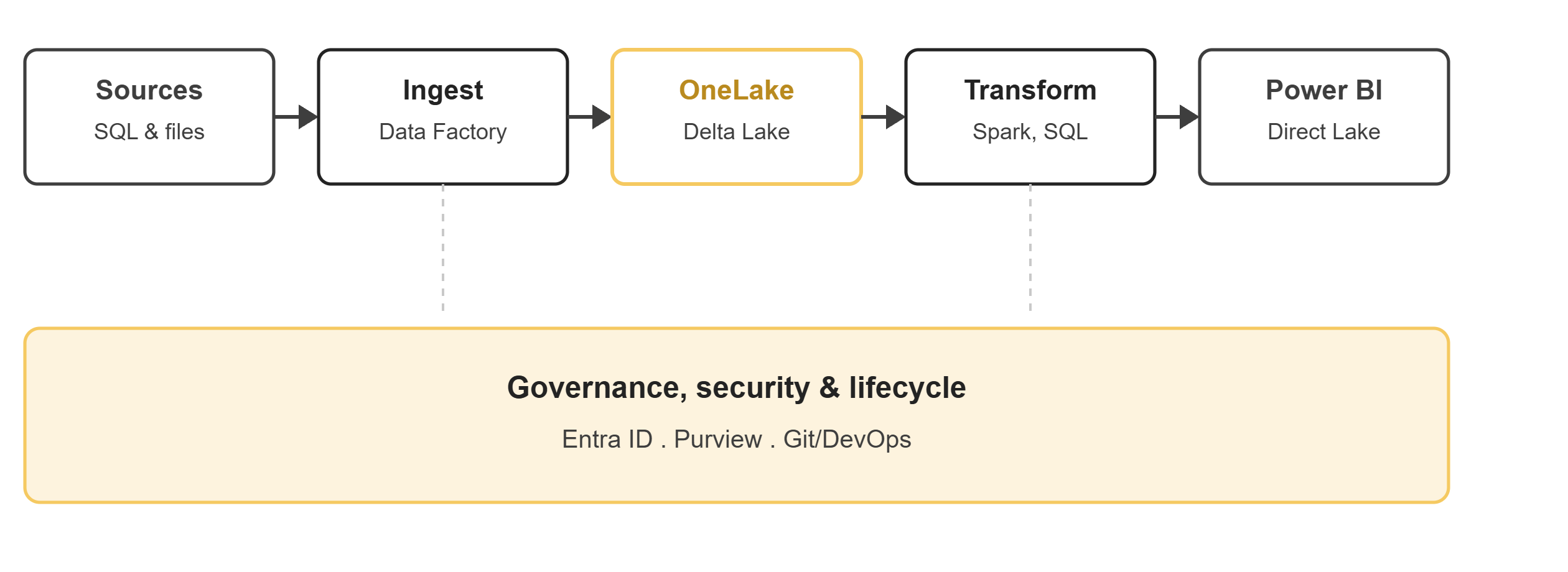
Figure 1: Target architecture: one governed copy of data in OneLake, prepared with Dataflow Gen2 or Spark, served to Power BI.
OneLake stores everything once in open Delta Parquet, so each workload reads and writes the same data. Power BI queries it through Direct Lake; operational databases can be mirrored in without ETL, and orchestration runs through Data Factory. Capacity is licensed through F-SKUs (from F2 up to F2048), with F64 the common threshold for the full set of Power BI capacity features.
How Do Business Needs Map to Fabric Components?
| Business Need / Workload | Fabric Component |
|---|---|
| Low-code data preparation | Dataflow Gen2 (Power Query) |
| Large-scale or complex transformation | Spark notebooks (Data Engineering) |
| SQL data warehouse | Fabric Warehouse |
| Data ingestion and orchestration | Data Factory pipelines |
| Operational data analytics without ETL | Database mirroring into OneLake |
| Streaming and event data | Real-Time Intelligence (Eventstream / KQL) |
| Interactive dashboards and reports | Power BI with Direct Lake |
| Single governed storage | OneLake (Lakehouse / Warehouse) |
| Identity and access control | Microsoft Entra ID + OneLake security |
| Catalog, lineage, and sensitivity labels | Microsoft Purview |
| Natural-language and AI-driven insights | Copilot and Fabric data agents |
| Source control and CI/CD | Git integration + deployment pipelines |
For the AI/Copilot row specifically, our AI/ML Consulting practice extends this to custom model work beyond Fabric's built-in agents.
Dataflow Gen2 vs. Notebooks vs. Data Factory: Which Should You Use?
| Aspect | Dataflow Gen2 | Spark Notebooks | Data Factory |
|---|---|---|---|
| Best for | Low-code data prep and transforms | Large-scale, complex, or custom logic | Ingestion, movement, and orchestration |
| Primary user | Analysts and BI developers | Data engineers | Data engineers |
| Interface | Visual Power Query | Code (PySpark, Scala, SQL) | Pipeline canvas |
| Choose when | Power Query parity and speed matter | Logic is heavy, iterative, or code-based | You need scheduling and cross-item flow |
What Are the Common Challenges in Fabric Projects?
- Capacity sizing. Guessing the F-SKU tier leads to throttling or wasted spend; size it against measured workload.
- Direct Lake conditions. Treating Direct Lake as automatic leads to unexpected fallback to import mode.
- Governance retrofits. Bolting on security and data lineage after go-live is the most common source of rework.
- Semantic model design. Carrying over legacy report models unchanged wastes Direct Lake performance; this is the same modeling discipline our Reports Conversion team applies when moving legacy reports onto a new platform.
- Migration assumptions. Expecting a lift-and-shift from Synapse, Databricks, or Snowflake will require refactoring.
- Cost visibility. Without monitoring and storage lifecycle rules, capacity and cloud spend quietly drift upward.
What Is the Recommended Engagement Approach?
- Assess: review readiness, inventory workloads and reports, size capacity against measured demand.
- Design: architect OneLake, workspace organization, medallion layers, and the security model, Entra ID with workspace roles and least-privilege OneLake security, up front.
- Implement and migrate: build pipelines, warehouse/lakehouse objects, and semantic models in phased waves.
- Validate: reconcile output against the source before anything goes live. Where legacy reports carry complex logic, our Reports Conversion team applies the same validation discipline here.
- Optimize: tune capacity, Direct Lake, and cost, using the Fabric monitoring hub and pipeline run history for ongoing observability.
- Enable: set up Git/CI-CD, document disaster-recovery expectations for OneLake resilience and capacity failover, and train the team to own it.
Best practices: size capacity on evidence rather than guessing; design governance and lineage first, before loading production data; pick the right workload per job; treat validation before cutover as a gate, not an afterthought.
A Typical Fabric Consulting Engagement
A mid-size organization runs reporting on a mix of an on-prem SQL Server warehouse, a standalone Power BI Premium capacity, and analyst-built data-prep workflows. Refreshes are slow, cloud spend is unpredictable, and governance is inconsistent. Leadership wants to standardize on Fabric but has no in-house experience.
The engagement sizes an F-SKU against measured workload, designs OneLake with medallion layers and a single Entra/Purview security model, moves the warehouse to Fabric Warehouse, rebuilds ingestion as Data Factory pipelines and Dataflow Gen2, and re-points Power BI to Direct Lake. Each report is reconciled against current output and run in parallel for a cycle before optimization tunes capacity, and the team is trained to run the platform. Organizations coming from Oracle-based reporting can see a closely related walkthrough in our Oracle to Microsoft Fabric Migration piece, and teams migrating from Alteryx should see Migrating from Alteryx to Microsoft Fabric.
Timeline, Cost, and Skills Required
- Timeline: driven by estate size and complexity, value arrives incrementally through phased waves rather than all at once.
- Cost and licensing: F-SKUs (F2 to F2048) are separate from consulting fees; right-sizing capacity is the main ongoing driver of cloud spend.
- Prerequisites: a Fabric capacity and workspace, source connectivity, and a clear set of goals and priority reports.
- Skills involved: SQL and Power Query, PySpark, Data Factory, Power BI modeling, governance with Entra ID and Purview, and Git/DevOps.
- Choosing a partner: look for real migration experience, a validation-first method, and enablement, so your team isn't left dependent, the same standard we apply in our Legacy Scripts modernization work.
Need a Microsoft Fabric Partner?
DataTerrain has helped 400+ clients design, migrate, and optimize enterprise data platforms over the past 17 years, using proprietary automation to move reports and pipelines between any BI platform and any other with minimal manual rework. We've run this playbook across a wide range of source platforms, including Alteryx, Informatica, OBIEE, Cognos, and legacy on-prem systems, into modern targets like Microsoft Fabric, Power BI, and AWS Glue, preserving workflow logic rather than rebuilding it from scratch. Bring us your data estate, and we'll assess it, design the Fabric architecture, migrate your workloads, tune capacity and cost, and hand your team a governed platform they can actually run, not a proof of concept that stalls before it reaches the business.
Ask about a Fabric readiness assessment →
Frequently Asked Questions
Related Reading
Oracle to Microsoft Fabric Migration | Migrating from Alteryx to Microsoft Fabric | Data Lake | AI ML Consulting | Migrating Legacy Systems to Cloud-Native BI Solutions | Oracle Analytics Server to Power BI Migration | ETL Data Migration: The Complete Guide | Cloud-Based ETL Tool | ETL Cloud Service by DataTerrain | Handling Schema Evolution in ETL Data Transformation | Best ETL Tools for Complex Data Transformation | ETL Solutions | Data Analytics Services