Contents
- 04 Aug 2026
Is Your Snowflake Consulting Partner Actually Delivering Results, or Just Delivering Invoices?
Organizations generating more data than ever before need a scalable, secure, and high-performance cloud data platform to consolidate analytics, govern access, and enable self-service analytics across the enterprise. Snowflake is that platform for thousands of enterprises worldwide, but adopting Snowflake alone is not enough. To extract full value: optimal architecture, governed data sharing, cost-controlled virtual warehouses, and AI-ready data pipelines - organizations need a Snowflake consulting partner with the implementation depth and migration tooling to deliver results. DataTerrain has delivered Snowflake consulting services across logistics, healthcare, finance, and enterprise analytics environments. This guide covers what Snowflake consulting includes, how the engagement works, and what each phase delivers.

- Share Post:
-

-

What Can Snowflake Actually Do That Your Current Platform Cannot?
Understanding Snowflake's core platform capabilities helps organizations assess where consulting services add the most value and what the platform makes possible that legacy data warehouses cannot.
| Capability | What It Delivers |
|---|---|
| Separation of compute and storage | Scale virtual warehouses up or down independently; pay only for active compute without affecting stored data |
| Multi-cluster virtual warehouses | Run multiple isolated compute clusters against the same data simultaneously with no resource contention between workloads |
| Multi-cloud architecture | Operate natively across AWS, Azure, and Google Cloud with the same SQL interface and security model on all three |
| Zero-copy data sharing | Share live, governed data with internal teams or external partners via Snowflake Marketplace without duplication or data movement |
| Automatic micro-partitioning | Snowflake automatically organizes data into micro-partitions and prunes irrelevant ones at query time, reducing data scanned per query |
| Time Travel and Fail-safe | Query, clone, or restore data from any point in the past 90 days; Fail-safe provides an additional 7-day recovery window after Time Travel expires |
| Cortex AI and Snowpark | Run LLM-powered analytics, ML model training, and Python/Java/Scala workloads directly on Snowflake data without moving it to external infrastructure |
| Dynamic data masking and RBAC | Enforce column-level masking, row access policies, and role-based access controls at the data layer, consistent across all connected BI tools |
What Is Snowflake and Why Are Thousands of Enterprises Switching to It?
Snowflake is a cloud-native data platform that separates compute from storage, enabling enterprises to scale each independently and pay only for what they use. Unlike traditional data warehouse platforms that provision fixed infrastructure for peak demand, Snowflake's virtual warehouses start, stop, and resize on demand: a structural advantage that eliminates the over-provisioning cost and performance ceiling of on-premises or fixed-capacity cloud data warehouses. Snowflake runs natively across AWS, Azure, and Google Cloud, making it the strongest choice for enterprises operating multi-cloud data environments. The Snowflake Marketplace enables live, governed data sharing between organizations without data movement, which is a capability that financial services, healthcare, and retail data ecosystems depend on. Cortex AI, Snowflake's built-in AI suite, brings LLM-powered analytics directly to enterprise data without requiring data to leave the governed Snowflake environment.
What Do Snowflake Consulting Services Actually Include?
Comprehensive Snowflake consulting services in 2026 cover eight interconnected service areas:
- Cloud readiness assessment: Evaluating the current data platform, identifying migration candidates, and defining the analytics objectives that the Snowflake environment will serve.
- Snowflake architecture design: Designing the data warehouse schema, defining virtual warehouse configurations, planning multi-cluster and cross-region architecture, and establishing the security and data governance framework.
- Data migration: Migrating from legacy platforms including Oracle, Teradata, IBM Db2, SQL Server, and Hadoop to Snowflake with schema conversion, SQL dialect migration, and parallel-run validation.
- ETL pipeline development: Building data pipelines that ingest from enterprise systems and load into Snowflake using tools including dbt, Fivetran, Matillion, and custom Spark-based pipelines.
- BI enablement: Connecting Power BI, Tableau, Looker, or other analytics tools to Snowflake through governed datasets and semantic layer design.
- Security and data governance: Implementing role-based access control (RBAC), row access policies, dynamic data masking, and column-level security within Snowflake.
- Cost optimization: Right-sizing virtual warehouses, implementing auto-suspend and auto-resume policies, configuring Snowflake credits monitoring, and tuning queries to reduce compute consumption.
- Cortex AI and ML enablement: Designing AI-ready data foundations with vector search readiness, governed access patterns, and Cortex AI feature configuration for LLM-powered analytics.
What Does a Snowflake Consulting Engagement Look Like Step by Step?
DataTerrain's Snowflake consulting engagement follows a structured six-phase workflow that takes organizations from initial assessment through production deployment and continuous support:
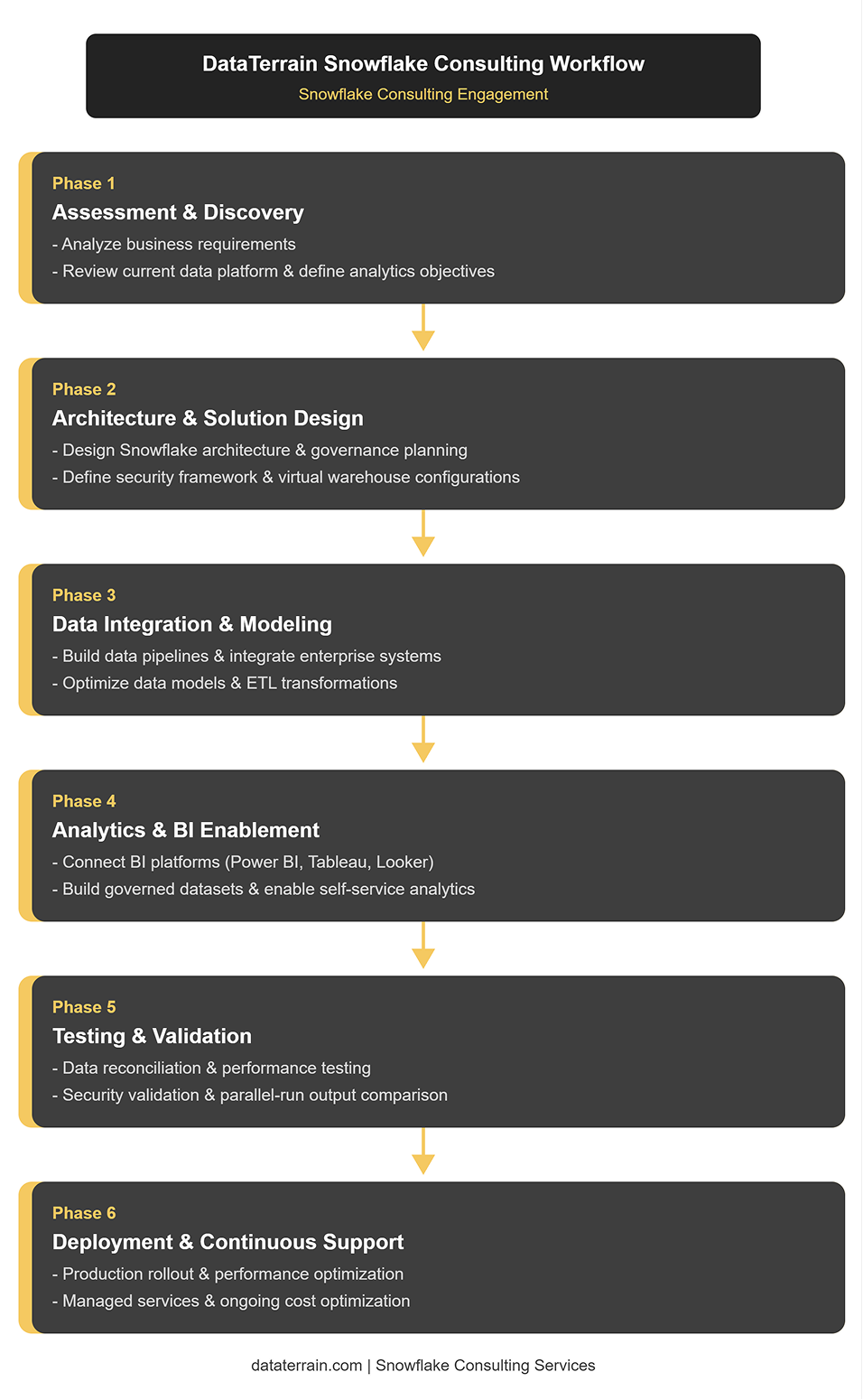
Phase 1: Assessment and Discovery
Every successful Snowflake implementation begins with a structured assessment phase that prevents costly architecture rework when organizations skip discovery and move directly to provisioning. DataTerrain's assessment covers the current data platform architecture, the complexity of the existing ETL pipeline, data volume and growth projections, analytics objectives and BI tool requirements, security and compliance constraints, and the total cost of the current environment. The output is a detailed business requirements document and a validated set of analytics objectives for the Snowflake environment.
Phase 2: Snowflake Architecture and Solution Design
The architecture phase translates assessment findings into a detailed Snowflake blueprint. Key decisions include virtual warehouse sizing and clustering configuration, multi-cluster warehouse design for concurrent workload isolation, data warehouse schema design (star schema, vault modeling, or medallion architecture depending on workload), data governance framework including role-based access control (RBAC), row access policies, and dynamic data masking policies, and Snowflake Marketplace data sharing architecture for organizations sharing data with partners or customers. Security architecture includes network policies, Snowflake's IP allow-listing, and private connectivity through AWS PrivateLink, Azure Private Link, or Google Cloud Private Service Connect. Governance planning at the architecture phase is significantly more cost-effective than retrofitting governance controls onto a live production environment.
Phase 3: Data Integration and Pipeline Development
The data integration phase builds the ETL pipelines and data pipelines that move data from enterprise source systems into Snowflake on a scheduled or event-driven basis. DataTerrain builds these pipelines using the tooling that best fits each organization's existing stack: dbt for SQL-based transformation, Fivetran or Airbyte for managed connector-based ingestion, custom Apache Spark or Python pipelines for complex transformation requirements, and Snowflake's native Snowpipe and tasks for simple continuous loading scenarios. Data models are designed within Snowflake to optimize query performance through proper clustering key selection, materialized views for frequently queried aggregations, and result cache utilization for repeated analytical queries.
Phase 4: Analytics and BI Enablement
BI enablement connects the Snowflake data foundation to the analytics tools business users rely on daily. DataTerrain connects Power BI, Tableau, Looker, and other analytics platforms to Snowflake through governed semantic layer datasets that enforce consistent metric definitions rather than allowing individual teams to create their own query definitions. For Power BI users, this includes Direct Query and import mode optimization against Snowflake virtual warehouses, Power BI dataset refresh scheduling aligned with Snowflake data pipeline completion, and row-level security configured at the Snowflake layer to enforce data access policies consistently across all connected BI tools. Self-service analytics capabilities are enabled by governed datasets, allowing business users to explore data within defined boundaries without IT involvement for every query.
Phase 5: Security, Governance, and Data Validation
Snowflake's native security capabilities are configured during this phase to meet the organization's compliance requirements. Role-based access control (RBAC) governs which users can access which databases, schemas, tables, and columns. Row access policies restrict which records each user or group can see within a shared table. Dynamic data masking applies field-level obfuscation for sensitive columns such as PII, salary data, or financial account numbers, showing masked values to non-privileged users without requiring separate physical copies of the data. Data validation confirms that all migrated datasets in Snowflake match their source-system counterparts through row-count reconciliation, aggregate-value comparison, and sample record-level checks before the production cutover.
Phase 6: Deployment, Cost Optimization, and Continuous Support
Production deployment follows a validated parallel-run period in which both the legacy environment and Snowflake run simultaneously, confirming that all reports, dashboards, and downstream processes produce consistent results on the new platform. Post-deployment, cost optimization is an ongoing practice rather than a one-time configuration. DataTerrain implements Snowflake credits monitoring via Snowflake's Query History and Resource Monitors, auto-suspend policies that shut down idle virtual warehouses within seconds of their last query, and query performance analysis to identify the specific queries consuming disproportionate compute credits. Organizations that implement structured cost-optimization practices consistently reduce their monthly Snowflake spend by 30 to 50 percent compared to self-managed environments without optimization expertise.
Is Your Snowflake Environment Ready for AI and Cortex?
Cortex AI is Snowflake's built-in AI suite that runs LLM-powered features directly on data within Snowflake without moving it to an external AI service. Features include text analytics, translation, sentiment analysis, document summarization, and the Cortex Analyst natural-language SQL interface, which allows business users to query data in plain English without writing SQL. DataTerrain designs the data foundation with Cortex AI readiness as an architectural objective from the start: including vector search infrastructure, governed access patterns for AI workloads, and Snowpark ML model deployment workflows. Organizations that plan for AI readiness from the start of their Snowflake implementation avoid the costly redesign that follows when AI initiatives mature on a platform not designed with them in mind.
Which Industries Are Getting Real Value from Snowflake Consulting?
Snowflake consulting requirements vary significantly by industry. Data volumes, compliance frameworks, analytical patterns, and integration complexity all differ. DataTerrain has delivered Snowflake implementations across four primary industry verticals:
- Financial services: Financial services organizations require Snowflake environments that support real-time risk analytics, regulatory reporting (Basel III, CCAR, DFAST), and PII masking for customer data. Virtual warehouse isolation separates production trading analytics from compliance reporting workloads, preventing resource contention during market volatility. Snowflake's dynamic data masking and row access policies address data residency and need-to-know access requirements common in banking and insurance environments.
- Healthcare: Snowflake implementations must comply with HIPAA requirements for PHI protection, including field-level encryption, audit logging, and access controls that restrict patient data access to authorized users. Snowflake's dynamic data masking consistently obfuscates PHI across all connected analytics tools without requiring separate masked copies of data. Clinical analytics workloads, claims processing pipelines, and population health dashboards all run against the same governed Snowflake environment with access controls enforced at the data layer.
- Retail and e-commerce: Retail Snowflake environments handle high-volume transactional data from POS systems, e-commerce platforms, and loyalty programs, as well as external market data. Snowflake Marketplace enables retailers to enrich their data with third-party demographic, weather, and location datasets without moving data. Seasonal demand peaks are handled through auto-scaling virtual warehouses that expand during promotional periods and contract during off-peak cycles, keeping compute costs aligned with actual business activity.
- Manufacturing and supply chain: Manufacturing Snowflake deployments integrate data from ERP systems (SAP, Oracle), IoT sensors, logistics platforms, and supplier systems into a unified analytics environment. Real-time supply chain visibility, production quality analytics, and predictive maintenance workloads all benefit from Snowflake's ability to run concurrent workloads against the same data without resource contention. Snowflake's multi-cloud support is particularly relevant for manufacturers with global operations spanning different cloud regions and regulatory jurisdictions.
What Are the Challenges Nobody Tells You About Snowflake Consulting?
Organizations that engage Snowflake consulting services consistently encounter the same set of challenges. Understanding them in advance allows consulting engagements to allocate resources appropriately and avoid the most common causes of delay and cost overrun.
- Governance frameworks are expensive to retrofit: Role-based access control, row access policies, and dynamic data masking are significantly more cost-effective to design during the architecture phase than to add to a live production environment with hundreds of tables and dozens of connected BI tools. Every Snowflake consulting engagement should treat governance design as a Phase 2 deliverable, not a post-launch task.
- Virtual warehouse sizing requires workload-specific analysis: Organizations that provision a single large virtual warehouse for all workloads consistently overspend. The right approach isolates ETL loading, interactive analytics, scheduled reporting, and ad hoc queries into separate warehouses sized for each workload's actual compute requirements, with auto-suspend configured to eliminate idle cost between runs.
- BI tool connection patterns affect performance: Connecting Power BI, Tableau, or Looker to Snowflake through DirectQuery or live connection modes places query load on Snowflake virtual warehouses at dashboard load time. Without proper warehouse isolation, dashboard performance degrades under concurrent user load. Consulting engagements should define connection patterns and warehouse allocation for BI workloads as part of the architecture design, not as a post-deployment tuning task.
- Cortex AI readiness cannot be added retroactively without cost: Organizations that build a Snowflake environment without considering AI workload patterns often face expensive redesign when AI initiatives mature. Vector search infrastructure, governed access patterns for LLM feature access, and Snowpark ML model deployment workflows are significantly easier to plan for at the architecture phase than to integrate into an existing production environment.
Best practices that apply across all Snowflake consulting engagements:
- Define cost budgets and Resource Monitor thresholds before the first production workload runs
- Use separate virtual warehouses for ETL, analytics, and ad hoc workloads from day one
- Design the semantic layer for BI tools during the architecture phase, not after dashboards are built
- Run parallel validation between legacy and Snowflake environments before decommissioning any source system
- Document clustering key decisions and query patterns during implementation for future optimization reference
Key Things to Remember About Snowflake Consulting Services
- Architecture decisions made at implementation are the most expensive to reverse: governance framework, RBAC design, and virtual warehouse configuration choices made in Phase 2 shape the cost and compliance posture of the Snowflake environment for years. Getting them right with expert guidance is consistently more cost-effective than correcting them post-deployment.
- Cost optimization is ongoing, not a one-time configuration: structured virtual warehouse right-sizing, auto-suspend policies, and query tuning reduce monthly Snowflake spend by 30 to 50 percent in environments that were self-implemented without optimization expertise.
- BI enablement requires a governed semantic layer design, not just connector setup: connecting Power BI or Tableau to Snowflake without a governed dataset layer can lead to conflicting metric definitions, which recreates the data fragmentation problem that Snowflake was adopted to solve.
- Cortex AI readiness must be planned from the architecture phase: retrofitting vector search, governing AI access patterns, and deploying Snowpark ML to a production Snowflake environment not designed for AI workloads is significantly more expensive than building it in from the start.
Final Thoughts
Snowflake consulting services are the difference between a cloud data platform that delivers on its promise and one that accumulates technical debt, governance gaps, and preventable cost. The six-phase engagement model - assessment, architecture, data integration, BI enablement, validation, and continuous support - addresses every dimension of a production Snowflake environment from the design decisions that are most expensive to reverse to the ongoing cost optimization practices that compound returns over time. Organizations that work with an experienced Snowflake consulting partner consistently reach production faster, operate at lower cost, and build a more scalable and governed foundation for self-service analytics, Cortex AI, and data sharing than those that navigate implementation on their own.
Why Do 400+ US Enterprises Choose DataTerrain for Snowflake Consulting?
DataTerrain is a specialist data platform implementation and ETL migration partner with over 17 years of experience and 400+ US clients. For Snowflake consulting engagements, DataTerrain delivers the full six-phase lifecycle from cloud readiness assessment through production deployment and ongoing cost optimization, with specific expertise in migrating legacy reports and ETL pipelines to Snowflake as part of the data platform transition. Whether you are implementing Snowflake for the first time, migrating from an on-premises data warehouse, or optimizing an existing Snowflake environment for cost and performance, DataTerrain brings the implementation depth to deliver results.
Contact us for a free Snowflake consulting assessment, or visit our website to explore the full range of data platform and analytics services.
Explore DataTerrain's Snowflake and Data Platform Services
- Automated BI Reports Conversion: converting legacy reports from any source platform to modern BI tools connected to your Snowflake environment
- ETL Migration Solutions: migrating legacy ETL pipelines to run against Snowflake as the target data platform
- Data Lake Services: building cloud data lake foundations that feed Snowflake analytics environments
- BI Products and Dashboard Development: building Power BI, Tableau, and Looker dashboards on Snowflake data
- Data Analytics Services: end-to-end analytics platform design and Snowflake implementation
- AI and ML Consulting: activating Snowflake Cortex AI and Snowpark ML capabilities
Frequently Asked Questions
Explore the Full Snowflake Consulting and Migration Library
AWS for Supply Chain Data Management | Amazon QuickSight Enterprise Analytics | ETL Migration Solutions | Snowflake Analytic Data Warehouse | Snowflake-Based Services for Enterprise | Alteryx vs Snowflake