Contents
- 05 Aug 2026
Alteryx to PySpark Migration: Tool Mapping, Real Pitfalls, and What Actually Takes Time
Mapping Alteryx tools to PySpark code is well documented; plenty of guides and tools cover it. What derails these migrations is different: Alteryx and Spark handle sorting, rounding, NULLs, and character encoding differently by default, and a conversion that looks correct can drift silently from the original numbers. This piece covers both: the tool mapping and the platform-behavior pitfalls that actually determine whether a migration succeeds.

- Share Post:
-

-

Key Takeaways
- Tool mapping is the easy part. Filter, Join, Union, Summarize, and Formula all translate cleanly into PySpark DataFrame operations; this is well documented across multiple current migration tools.
- Platform-behavior differences are what actually cause failures: deterministic ordering, FixedDecimal vs. Double rounding, NULL semantics, and Unicode/ODBC-driver character stripping all differ between Alteryx and Spark by default.
- Databricks is the most common target, alongside AWS EMR, AWS Glue, and Microsoft Fabric.
- Validation is what actually determines success, not automation percentage alone.
- DataTerrain delivered a real 34-workflow migration in 450 hours, 90% automated, with every output column validated against the source before cutover.
What Is Alteryx?
Alteryx Designer is a desktop-based data preparation and analytics platform used across enterprises, offering a visual drag-and-drop interface for building data transformation workflows that connect to databases, blend data from multiple sources, apply business logic through formula expressions, and produce output files or database loads.
Alteryx workflows encode complex business logic through chains of visual tools: joins, filters, formulas, aggregations, and iterative macros. Over time, organizations build portfolios of dozens or hundreds of workflows deeply embedded in daily operations, which is exactly what makes migrating them non-trivial.
Why Are Organizations Migrating from Alteryx to PySpark?
- No licensing costs. PySpark is open-source, with no per-user or per-server fees, a direct source of savings for organizations running large Alteryx portfolios.
- Horizontal scalability. Spark distributes computation across clusters. Workloads that bottleneck on a single Alteryx machine scale horizontally with no code changes.
- Cloud-native integration. PySpark runs natively on AWS (EMR, Glue), Azure (Databricks, Fabric), and GCP (Dataproc), integrating directly with data lakes, warehouses, and orchestration services.
- Industry-standard skills and easier hiring. PySpark is built on Python, giving teams access to a much broader talent pool than a desktop-licensed visual tool.
- Centralized governance. Code in version control, reviewed through standard engineering practices, replaces logic locked inside individual desktop workflow files.
Who Should Consider an Alteryx to PySpark Migration?
This migration makes the most sense for:
- Organizations with 50+ Alteryx workflows, where licensing costs and maintenance overhead compound significantly.
- Teams already moving to Databricks or Microsoft Fabric as part of a broader platform consolidation.
- Enterprises adopting cloud data lakes, where Alteryx's desktop-bound architecture becomes a structural mismatch.
- Companies specifically targeting licensing cost reduction as a budget priority.
- Organizations standardizing engineering teams on Python and Spark, where a separate visual tool adds friction rather than removing it.
Alteryx vs. PySpark: Tool Mapping Reference
Most core Alteryx tools map cleanly to PySpark DataFrame operations:
| Alteryx Tool | PySpark Equivalent |
|---|---|
| Input / Output | spark.read.format("parquet").load("path") / df.write.save("path") |
| Select (Rename/Cast) | df.withColumnRenamed("old", "new").withColumn("col", col("col").cast("int")) |
| Filter | df.filter(col("age") > 30) |
| Join | df1.join(df2, on="id", how="inner") |
| Union | df1.unionByName(df2) |
| Summarize (Group By) | df.groupBy("category").agg(sum("sales").alias("total")) |
| Sort | df.orderBy(col("date").desc()) |
| Formula | df.withColumn("new_col", expr("col1 + col2")) |
| Multi-Row Formula | Window functions (lag(), lead()) over a defined partition and order |
| Cross Tab | df.groupBy(...).pivot("column").agg(...) |
This mapping covers the syntax. It doesn't cover whether the result matches; that depends on the platform-behavior differences below. For teams building custom transformation logic beyond what standard tool mapping covers, our Custom ETL Workflows with Python Scripting piece covers Pandas, PySpark, and SQLAlchemy patterns in more depth.
Automated vs. Manual Conversion: What Actually Splits That Way
| Tool / Logic Type | Typically Automated | Typically Requires Manual Work |
|---|---|---|
| Filter, Select, Sort | Yes | Rarely |
| Join | Yes | When output anchors are ambiguous |
| Formula | Yes | When NULL/rounding semantics differ |
| Summarize | Yes | When tied to First()/Last() ordering |
| Complex macros | No | Always, requires redesign |
| Recursive/iterative workflows | No | Always, converted to checkpointed loops |
| Custom Python-embedded logic | Partial | Usually, needs review line by line |
| Performance tuning | No | Always, done post-conversion |
The pattern holds across most engagements: straightforward, well-scoped tools automate reliably. Anything involving iteration, recursion, or embedded custom code needs engineering judgment, not just a converter.
Why Migrating Alteryx Workflows Is Harder Than It Looks
Most migration attempts underestimate the technical depth required, because tool mapping is well-documented but platform behavior isn't:
- Deterministic ordering. Alteryx processes rows in a fixed internal order that Spark doesn't guarantee. When a Sort tool feeds a Summarize using First() or Last(), ties in the sort key produce different results between platforms unless explicit tiebreakers are added.
- FixedDecimal vs. Double precision. Alteryx uses banker's rounding at fixed precision and scale; Spark defaults to HALF_UP. Results diverge at exact midpoints, and the drift accumulates through intermediate calculations, invisible without column-level comparison.
- NULL handling. A comparison involving NULL returns false in Alteryx but NULL in Spark. Every conditional and aggregation must be traced individually, since naive fixes like coalescing to zero change the comparison semantics entirely.
- Iterative macro conversion. Alteryx's iterative macros, used for hierarchical data expansion, have no direct Spark equivalent. Converting them requires Python loops with lineage breaking and checkpointing to avoid execution-plan explosion and out-of-memory errors at scale.
- Non-breaking spaces and Unicode. Alteryx's ODBC driver silently strips characters that Spark's JDBC driver keeps, breaking join keys invisibly. The stripping must be replicated at the exact position in the Alteryx tool flow.
- Join type verification. The Alteryx Join tool's connected or disconnected output anchors decide which rows are kept or silently dropped. The correct Spark join must be determined from the metadata, not assumed from the tool name.
Even Databricks' own community has acknowledged this directly: a recent Databricks community discussion on its Lakebridge migration tool states that it "is useful for an Alteryx migration, but it is not a documented one-click Alteryx-to-PySpark converter"; tool translation and full migration are not the same thing. These are exactly the kind of platform-behavior gaps our Converting Alteryx Workflows to Python piece touches on more broadly; code-first tools expose these differences directly rather than hiding them behind a visual interface.
What a Migration Must Get Right
| Capability | What It Solves |
|---|---|
| Metadata-level workflow analysis | Surfaces every tool, join anchor, sort dependency, data type, and encoding behavior before any code is written |
| Automated conversion | Translates the majority of each workflow into production-ready PySpark at scale |
| Platform-behavior replication | Reproduces Alteryx's ordering, rounding, NULL, and Unicode behavior on a distributed engine |
| Zero-defect validation | Compares every output column against Alteryx and resolves every difference before cutover |
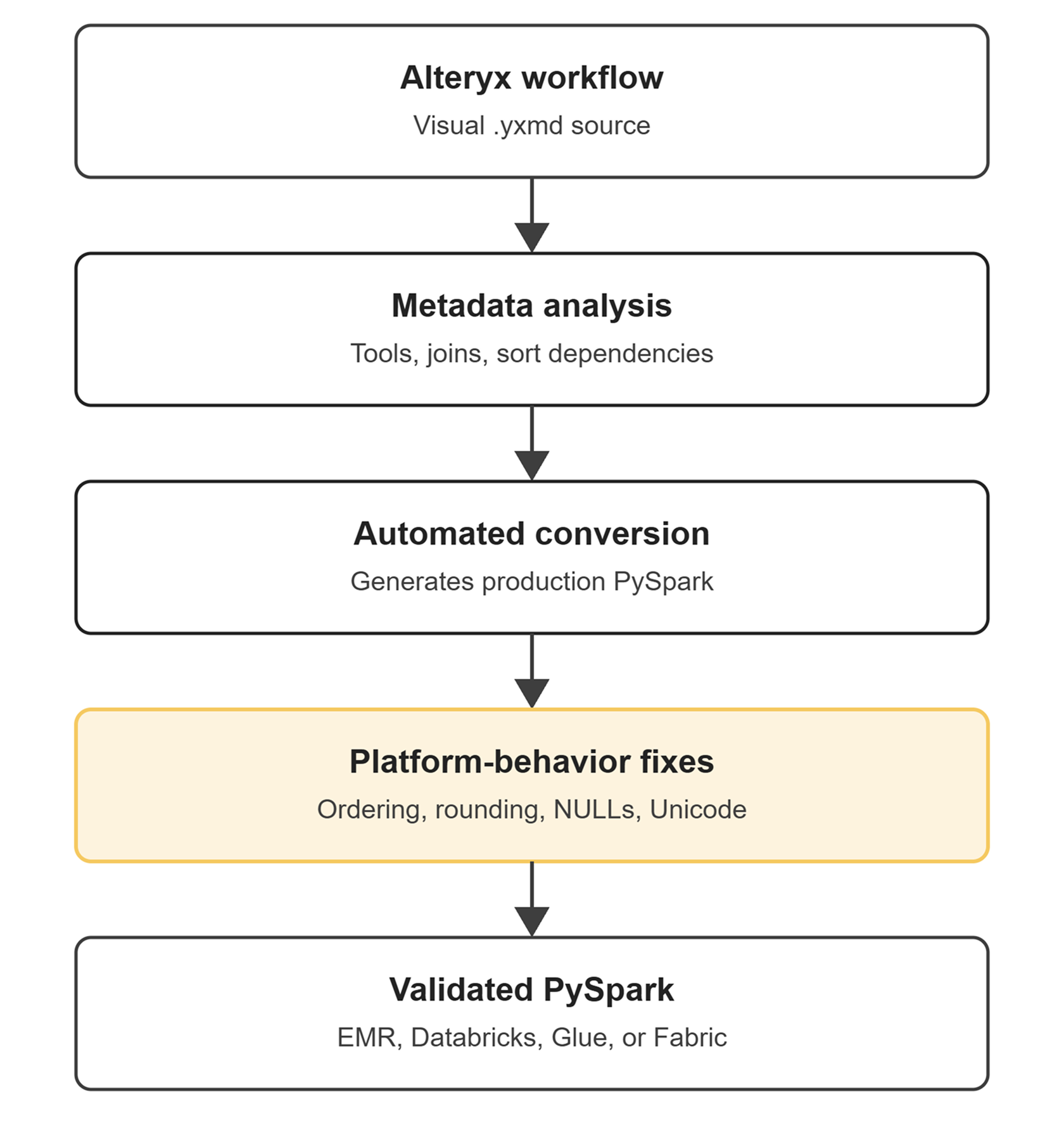
Figure 1: The Alteryx to PySpark migration pipeline, from source workflow to validated output.
That's a five-stage pipeline diagram matching the blog's core argument: source workflow → metadata analysis → automated conversion → the platform-behavior fixes (highlighted in amber since that's the step most migrations underestimate) → validated output on whichever target platform you're using.
Typical Phases of an Alteryx to PySpark Migration
- Discovery: inventory workflows, macros, connectors, schedules, and dependencies across the portfolio.
- Workflow assessment: score each workflow by complexity, flagging iterative macros and heavy custom logic for extra attention.
- Automated conversion: generate production-ready PySpark for the majority of the portfolio.
- Manual optimization: hand-refine the platform-behavior-sensitive logic automation can't safely handle alone.
- Validation: reconcile every output column against the Alteryx source.
- Performance testing: benchmark against expected data volumes and SLAs before go-live.
- Production deployment: cut over with a rollback path available.
- Hypercare: a defined post-launch monitoring window to catch anything validation didn't surface.
Which Platform Is Best for PySpark?
| Platform | Best For |
|---|---|
| Databricks | Lakehouse analytics, notebook-based development, Delta Lake |
| AWS Glue | Serverless ETL, script-based jobs, tight AWS integration |
| AWS EMR Serverless | Large-scale Spark clusters, S3/Redshift/Step Functions integration |
| Microsoft Fabric | Organizations standardized on the Microsoft ecosystem, OneLake storage |
| GCP Dataproc | Teams already standardized on Google Cloud |
Teams considering AWS Glue specifically should see our Alteryx to AWS Glue ETL Migration piece, and teams targeting Fabric should see our Alteryx to Microsoft Fabric Migration and Challenges piece.
Migration Decision Matrix
| Scenario | Recommendation |
|---|---|
| Small workflow inventory (fewer than 10-15 workflows) | Manual conversion is often faster than setting up automation tooling |
| Large portfolio (50+ workflows) | Automated, metadata-driven conversion |
| Heavy iterative macro usage | Metadata-driven approach with dedicated engineering time for macro redesign |
| Strict validation or regulatory requirements | Column-level, row-by-row comparison against source, not spot-checking |
Performance Optimization After Migration
Getting the migration correct is step one; getting it fast is a separate, follow-on effort:
- Partitioning: align partition keys with common filter and join columns to avoid full-table scans.
- Broadcast joins: broadcast small lookup tables instead of shuffling large datasets across the cluster.
- Caching: cache intermediate DataFrames reused across multiple downstream steps.
- Adaptive Query Execution (AQE): enable Spark's AQE to let the engine re-optimize join strategies and partition counts at runtime.
- Delta Lake optimization: use OPTIMIZE and Z-ordering on Delta tables to reduce file fragmentation over time.
- Cluster sizing: right-size worker count and instance type against actual measured workload rather than guessing upfront.
Migration Challenges, and How DataTerrain Solves Them
| The Challenge | How We Solve It |
|---|---|
| Implicit sort ordering produces different results on Spark | Every sort dependency identified through metadata analysis; deterministic tiebreakers applied |
| Rounding differences cause silent numerical drift | Alteryx FixedDecimal arithmetic replicated at exact precision and scale in PySpark |
| NULL comparisons behave differently across platforms | Each conditional expression individually traced and verified for NULL equivalence |
| Iterative macros have no Spark equivalent | Converted to Python loops with lineage breaking and checkpointing for scale |
| Hidden characters cause join failures | Non-breaking spaces and Unicode control characters stripped at the correct processing step |
| Join outputs silently drop rows when disconnected | Alteryx metadata inspected to determine which output anchors are connected before writing join logic |
The tool is not the hard part. The years of business logic encoded inside it is.
Common Alteryx to PySpark Migration Mistakes
- Assuming tool mapping alone is sufficient. A syntactically correct conversion can still produce wrong numbers if platform behavior isn't addressed separately.
- Ignoring data type and precision differences, particularly FixedDecimal vs. Double.
- Missing NULL semantics, especially in conditionals and aggregations that behave differently across platforms.
- Not validating every output column. Spot-checking a sample of rows misses discrepancies that only surface in edge cases.
- Skipping performance testing before go-live. A functionally correct pipeline that's too slow at production volume is still a failed migration.
- Converting iterative macros literally instead of redesigning them. A one-to-one translation attempt for hierarchical macros typically fails or performs badly at scale.
Best Practices for Alteryx to PySpark Migration
- Convert incrementally, in waves, rather than attempting the entire portfolio at once.
- Validate every workflow, not a representative sample.
- Benchmark performance against real data volumes before calling the migration complete.
- Preserve metadata and documentation from the original Alteryx workflows for future reference.
- Standardize coding conventions across the converted codebase to prevent it from becoming a second layer of undocumented logic.
- Document every assumption made during conversion, especially around ambiguous join anchors or macro redesign decisions.
When Not to Migrate
Migration isn't automatically the right call in every situation:
- A small, stable workflow inventory with no near-term growth or licensing pressure may not yet justify the migration effort.
- The lack of available Spark expertise, either in-house or through a partner, makes a rushed migration riskier than temporarily staying put.
- Short-term licensing constraints that will resolve on their own (such as a contract renewal a few months out) may not warrant an urgent migration.
- An upcoming platform retirement or replacement already planned elsewhere in the stack may make this the wrong time to invest specifically in an Alteryx migration.
Alteryx to PySpark Migration Readiness Checklist
- Inventory all workflows and macros across the portfolio
- Identify custom connectors and non-standard data sources
- Review scheduling dependencies between workflows
- Validate source and target schemas before conversion begins
- Document business rules embedded in complex formulas and macros
- Plan for parallel testing against the existing Alteryx environment
- Define a rollback strategy before cutover, not after a problem appears
How DataTerrain Approaches It
Metadata-level workflow analysis. Every workflow is analyzed at the metadata level, every tool, connection, formula, join anchor, sort dependency, data type, and character encoding behavior identified before any code is written. This is a complete technical audit, not pattern matching. Our ETL testing automation practice applies this same rigor specifically to the validation layer.
Zero-defect validation. Every output column in every table is compared between the original Alteryx output and the converted PySpark output, with every difference investigated to root cause and resolved before delivery. No variance is accepted without explanation.
Choosing a Migration Partner
Not every provider approaches this the same way. Worth evaluating specifically:
- Metadata analysis capabilities: does the assessment go deeper than a surface-level tool count?
- Automation coverage: what percentage of typical workflows convert automatically versus requiring manual rebuild?
- Validation methodology: column-level comparison against source, or spot-checking?
- Spark expertise, genuine platform-behavior knowledge, not just tool-mapping familiarity.
- Reference projects: a real, verifiable engagement at comparable scale.
- Post-migration support: what happens if an issue surfaces after cutover?
Case Study: A Global Electronic Components Manufacturer
A global manufacturer of electronic connectors and interconnect solutions, serving customers in more than 100 countries, engaged DataTerrain to migrate its Alteryx workflow portfolio to PySpark on Amazon EMR Serverless.
Business challenges: a large portfolio of complex Alteryx workflows, including iterative macros and hierarchical data expansion; workflows that process large-scale data with multi-source joins and conditional logic; significant Alteryx licensing costs; and zero tolerance for data discrepancies in production output.
What DataTerrain delivered: complete migration of the workflow portfolio to PySpark on EMR Serverless, metadata-level analysis of every workflow before conversion, custom solutions for FixedDecimal rounding, NULL handling, sort tiebreakers, and Unicode stripping, column-by-column validation across every output table, and parallel production runs confirming accuracy before cutover.
Results: 34 workflows migrated in 450 hours, 90% automated, with per-seat Alteryx licensing eliminated, every workflow now running on distributed cloud infrastructure, every output column validated with zero unresolved data discrepancies, and the client continuing to expand PySpark adoption on AWS.
See the full Alteryx to PySpark on AWS customer story for the complete write-up.
Why This Matters
| Capability | Business Outcome |
|---|---|
| Metadata-level analysis | No silent discrepancies from missed ordering, joins, or encoding |
| FixedDecimal replication | Numbers match Alteryx exactly, no accumulated rounding drift |
| Column-by-column validation | Data integrity proven before cutover, not assumed |
| Automated conversion | 90% of conversion work automated, delivered in 450 hours across 34 workflows |
| Open-source PySpark | Recurring Alteryx licensing costs eliminated |
| Distributed cloud processing | Workloads scale beyond a single Alteryx machine |
How DataTerrain Helps
Choosing a migration partner comes down to who can guarantee the numbers still match when workflows the business runs on every day move to a new engine. DataTerrain brings deep dual-platform expertise in both Alteryx and Spark internals, the only reliable way to catch the silent discrepancies in ordering, rounding, NULLs, and encoding that derail these migrations. Our ETL Migration Solutions practice runs automation-first conversion backed by zero-defect, column-by-column validation, the same approach behind 400+ client engagements over 17 years, extending to related modernization work through our Legacy Scripts practice for teams moving off other legacy platforms at the same time.
Conclusion
Tool mapping is only one part of an Alteryx-to-PySpark migration, and the smaller part at that. Runtime behavior differences, deterministic ordering, FixedDecimal rounding, NULL handling, and Unicode fidelity are what actually determine whether a migration succeeds or silently produces wrong numbers. Validation isn't a final checkbox; it's the mechanism that proves business logic survived the move intact. An automation-first, metadata-driven approach reduces both risk and timeline, but only when paired with genuine platform-behavior expertise and column-by-column validation, rather than automation alone.
Planning an Alteryx Migration?
Talk to a DataTerrain Alteryx Migration Specialist →