Contents
- 16 Sep 2026
ETL Migration to Microsoft Fabric: Racing the Deadlines
ETL migration to Microsoft Fabric moves ingestion, transformation, and orchestration off a legacy platform (Informatica PowerCenter, Talend, SSIS, DataStage, Alteryx, or custom scripts) onto Fabric's Data Factory pipelines, Dataflow Gen2, Spark notebooks, and OneLake. It is a refactor, not a lift-and-shift: data movement is straightforward, but business logic, error handling, and scheduling all need rebuilding in Fabric's own model. Run with reconciliation as a gate before cutover; it is predictable, well-understood work.
Legacy ETL estates are reaching their deadlines together. Informatica PowerCenter 10.5x left standard support in March 2026, with paid extended support running only to March 2027. Talend 7.3 reached end of life in November 2024, and its extended support expires in December 2026. SSIS estates inherit support from the underlying SQL Server version. For organizations already standardized on Microsoft, that turns separate support notices into one platform decision.
Quick Summary
ETL migration to Microsoft Fabric moves ingestion, transformation, and orchestration off a legacy platform and onto Data Factory pipelines, Dataflow Gen2, Spark notebooks, and OneLake. It is a refactor, not a port: data movement is the easy part, while business logic, error handling, and scheduling all need rebuilding. Run each migration wave through reconciliation before cutover. With a clear inventory, component mapping, and validation process, legacy ETL modernization becomes a structured and manageable engineering effort.

- Share Post:
-

-

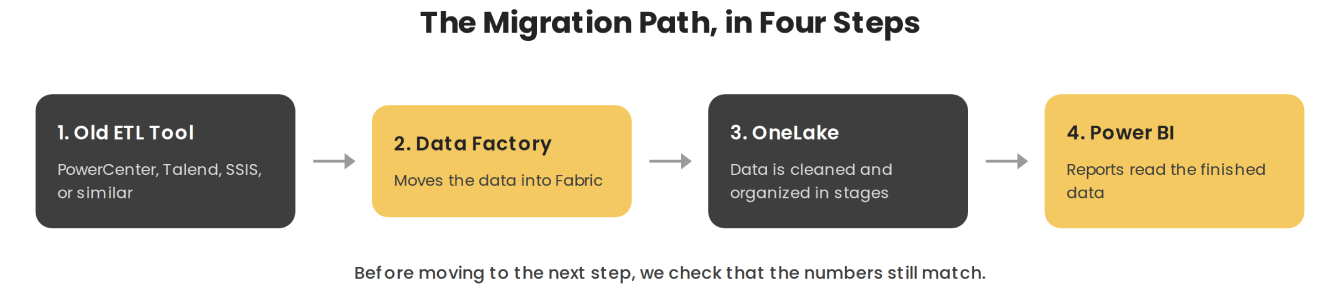
Figure 1: Legacy ETL replaced by Data Factory ingestion into a medallion OneLake, transformed and served to Power BI, with reconciliation gating each wave.
Key Takeaways
- The deadlines are real and close together. PowerCenter extended support ends March 2027, and Talend 7.3 support ends December 2026, which is why so many estates are moving at once.
- Migration is refactoring, not lift-and-shift. No legacy ETL tool maps one-to-one onto Fabric; expect to rebuild logic in Fabric's model.
- Assessment should come before conversion. Compatibility assessment and asset discovery help identify which pipelines, schemas, transformations, and dependencies can move directly and which require redesign.
- Inventory before you estimate. Legacy ETL estates often contain unused, duplicated, or obsolete jobs, so estimating before completing an inventory can lead to inaccurate scope and cost assumptions.
- Reconciliation is the gate. Switching off the source platform before a full parallel cycle has matched output is the most expensive mistake you can make.
- The direction can run either way. Most estates move toward Fabric given the support deadlines, but organizations leaving Fabric for another platform follow the same inventory-map-convert-reconcile discipline in reverse.
What Is ETL Migration to Microsoft Fabric?
ETL migration to Microsoft Fabric is the conversion of an existing integration estate, jobs, mappings, transformations, parameters, and schedules, into Fabric equivalents, with data landing once in OneLake and orchestration running in Data Factory. In practice, it is a Data Factory pipeline migration for the orchestration layer and an ETL to Dataflow Gen2 conversion for low-code transformation, with heavier or procedural logic moving to Spark notebooks- the same layered rebuild covered in our Talend to Microsoft Fabric migration guide for one specific source platform.
Microsoft's own Fabric Migration Assistant helps assess compatibility before conversion begins, evaluating legacy pipelines and database schemas, often via DACPAC files or direct source connections, for how cleanly they'll translate. Data typically lands in OneLake or a staging Lakehouse, using native copy jobs or COPY INTO commands rather than row-by-row legacy connectors, the same staging-first approach covered in our data lake work.
The target is usually a medallion architecture in Fabric: bronze for raw landing, silver for conformed data, and gold for what the business consumes, served to Power BI through Direct Lake. Fabric tends to win where the organization already runs on Entra ID, Purview, and Power BI, because governance and consumption arrive with the platform rather than being assembled around it- the same ecosystem-fit reasoning covered in our Azure to Microsoft Fabric migration guide.
Why Enterprises Are Modernizing Legacy ETL
- Support is expiring. PowerCenter 10.5x left standard support in March 2026, with extended support to March 2027 and sustaining support to 2029; Talend 7.3 support ends in December 2026, the same deadline pressure covered in our Informatica PowerCenter on AWS guide for organizations weighing a different modernization path.
- Unpatched estates become compliance problems. Once vendor patches stop, CVEs accumulate against systems that usually sit on regulated data.
- Skills are draining away. Specialists in legacy ETL tools are harder to hire each year, and the people who wrote the original jobs have often left.
- Cost stacking. Extended support fees, a separate server estate, and a separate license line survive only as long as the platform does.
- Consolidation. Where Power BI is already the consumption layer, moving ETL into Fabric removes an entire tier from the architecture, the same consolidation logic covered in our Databricks to Microsoft Fabric migration guide.
Which Source Platforms Move to Fabric?
| Source Platform | What Drives the Move | Conversion Profile |
|---|---|---|
| Informatica PowerCenter | Support ends March 2027 | Mappings convert predictably; heavy workflow logic is the exception |
| Talend | 7.3 support ends December 2026 | Jobs map well; custom Java is the risk |
| SSIS | Tied to the SQL Server version beneath it | Closest fit to Data Factory; script tasks are the exception |
| IBM DataStage | License cost and mainframe ties | Parallel jobs need redesign, not translation |
| Alteryx | Analyst-owned logic moving to engineering | Set-based steps port; macros and apps do not |
| Legacy scripts and stored procedures | No owner, no documentation | Often the cheapest to move and the hardest to verify |
Organizations working from Oracle sources specifically, PL/SQL, ODI, or Oracle-based ETL, follow a related but distinct path; see our ODI (Oracle Data Integrator) ETL guide for that source platform directly.
ETL Asset Mapping to Fabric Components
| Legacy ETL Asset | Fabric Equivalent |
|---|---|
| Workflow or job orchestration | Data Factory pipeline |
| Low-code mapping and transformation | Dataflow Gen2 (Power Query) |
| Complex, procedural, or looping logic | Spark notebook |
| Parameters and environment variables | Pipeline parameters, variable libraries |
| Scheduler and dependency chains | Pipeline schedules and triggers |
| CDC and incremental extracts | Mirroring or incremental Copy |
| Staging and landing areas | OneLake bronze layer |
| Conformed dimensions and marts | Silver and gold layers, Fabric Warehouse |
| Data quality rules | Dataflow validation plus Purview |
| MDM and ESB modules | No direct equivalent; a separate decision |
Step-by-Step Migration Process
The target and the method are the same regardless of source platform: land data once, transform it in layers, and gate every wave on reconciliation.
- Inventory and retire. Catalog every job, schedule, and downstream consumer, then delete what is dead before converting anything.
- Map and flag. Classify each asset against the table above and identify anything with no Fabric equivalent before committing to a plan.
- Design the target. Workspaces, medallion layers, and the security model, designed once rather than per wave.
- Convert in waves. By business process rather than by job, so each wave produces something the business recognizes.
- Reconcile and run in parallel. Match row counts, column values, and totals, then run both platforms through a full cycle including month-end, the same validation discipline covered in our guide to BI automation for report migration.
- Cut over and decommission. Release licenses and servers only after the final wave is signed off, then size the F-SKU from measured demand.
Common ETL Migration Challenges
- Undocumented logic. Custom code inside jobs holds business rules nobody has read in years and is consistently the largest source of schedule overrun.
- Components with no equivalent. MDM, ESB, and specialist matching or data-quality modules need their own decision, not a workaround inside Fabric.
- Error handling and restartability. Legacy error flows and checkpoints have to be rebuilt in pipeline activities, not assumed.
- Semantic drift. Null handling, type coercion, and rounding differ between platforms, producing small reconciliation mismatches that must be explained rather than tolerated- the same validation discipline covered in our guide to automating ETL testing with Python.
- Legacy connector performance. Forcing an on-premises ETL tool to write into Fabric Warehouse over JDBC or TDS, row by row, hits real throughput limits. Fabric-native pipelines and bulk copy patterns consistently outperform legacy connector workarounds.
- Capacity sizing. Guessing the F-SKU from the old server specification leads to throttling or waste; size it once pipelines are running.
ETL Migration Best Practices
- Retire before you convert. Every dead job removed is one you never convert, reconcile, or maintain again- the same rationalize-first discipline covered in our key checklist for BI modernization.
- Design governance into the first wave. Access control, lineage, and Git-based promotion are far harder to retrofit once hundreds of pipelines exist.
- Treat reconciliation as a gate, not a report. No wave goes live until its output matches for the same input window.
- Keep the source platform running until sign-off. One cycle of license overlap is cheaper than reversing a failed cutover.
- Plan for enablement. The migration succeeds when your team can run and extend the pipelines without the partner.
Moving in the Other Direction: Microsoft Fabric to Another ETL Platform
Most traffic in this space moves toward Fabric, given the PowerCenter and Talend support deadlines, but a Microsoft Fabric-to-ETL-platform migration is a real, if less common, scenario worth addressing directly. Organizations consider moving off Fabric when they need capabilities Fabric doesn't natively provide, MDM and ESB modules being the clearest example, when they're standardizing on a different cloud provider, or when a merger or divestiture puts them on a different corporate data platform standard.
The mapping runs in reverse from the table above: Data Factory pipelines become the target platform's workflows or jobs, Dataflow Gen2 transformations become the target platform's low-code equivalent, and Fabric's Purview-based governance needs to be re-expressed in whatever governance layer the new platform provides. The same reconciliation-as-a-gate discipline applies regardless of direction, and the same six-step process- inventory, map, design, convert, reconcile, cut over- holds with the source and target reversed. For teams moving specifically from Fabric to Informatica, our Microsoft Fabric to Informatica ETL conversion guide covers that direction directly; for Fabric to Snowflake, see our Microsoft Fabric to Snowflake ETL conversion guide.
Case Study: Legacy ETL Consolidation
The following is an illustrative example, not an account of a specific customer engagement. No customer names, figures, or performance results are implied.
A distributor runs two ETL platforms side by side, an aging PowerCenter estate feeding the enterprise warehouse and a set of SSIS packages built later by a different team, both landing in SQL Server and surfacing through Power BI. Support deadlines on one platform and no owner on the other force the decision.
The combined inventory identifies a meaningful number of jobs that are unused, duplicated across the two tools, or feeding reports that are no longer actively consumed. The rest map to Data Factory pipelines and Dataflow Gen2, with a small number of procedural mappings rebuilt as notebooks and landing in a medallion OneLake. Waves are converted by reporting chain, each reconciled against current output and run in parallel through a month-end close, and both source platforms are decommissioned only once the final chain is signed off, removing two license lines and one server estate.
Frequently Asked Questions
Planning an ETL Migration?
DataTerrain helps organizations assess, map, and modernize legacy ETL environments across Informatica, Talend, SSIS, DataStage, Alteryx, and custom data pipelines. Our approach starts with asset discovery and rationalization, maps each workload to the appropriate target architecture, and validates every migration wave through reconciliation before cutover.
Start with a representative Proof of Concept to evaluate the migration approach against your actual ETL workloads.
Related Reading
Talend to Microsoft Fabric Migration | Azure to Microsoft Fabric Migration | Databricks to Microsoft Fabric Migration | Alteryx to Microsoft Fabric Migration and Challenges | Microsoft Fabric to Informatica ETL Conversion | Microsoft Fabric to Snowflake ETL Conversion | Snowflake vs Microsoft Fabric | Informatica PowerCenter on AWS: The Complete ETL Guide | ODI (Oracle Data Integrator) ETL Guide | ETL to Informatica | ETL to SnapLogic | ETL to AWS Glue | ETL to Informatica IICS | Automating ETL Testing with Python: Data Validation | Key Checklist for Successful BI Modernization