Contents
- 14 Aug 2026
Alteryx vs AWS Glue: Choosing the Right ETL Engine for Cloud-Scale Data
Alteryx vs AWS Glue is a decision between two fundamentally different models: desktop-centric, per-seat analytics automation versus serverless, pay-as-you-go cloud ETL. This guide covers the pricing, architecture, governance, and a proven migration path between them.
Key Takeaways
- Different tools for different jobs. Alteryx is desktop-first analytics automation for individual analysts; AWS Glue is serverless, Spark-based ETL for engineering teams at cloud scale.
- Pricing models are fundamentally opposed. Alteryx charges per named user per year (~$5,195 for Designer, quote-based for Server). AWS Glue charges per DPU-hour ($0.44) with per-second billing and no idle cost.
- Alteryx wins on speed-to-value for analysts. Its drag-and-drop canvas lets non-coders build workflows in hours, with no infrastructure to manage.
- AWS Glue wins on scale, elasticity, and total cost at volume. It handles terabyte-scale distributed processing and integrates natively with S3, Redshift, Athena, and Lambda.
- Migration is a rewrite, not a lift-and-shift. Alteryx tools are re-expressed as PySpark logic on Glue; the payoff is lower licensing cost and cloud-native elasticity.
Alteryx vs. AWS: Why the Comparison Is Actually Alteryx vs. AWS Glue
Many searches phrase this as "Alteryx vs AWS," but that's not quite the right comparison. AWS is a cloud platform with hundreds of services, including S3 for storage, Lambda for automation, SageMaker for machine learning, and Glue for ETL. Alteryx is one product. The fair, direct comparison is Alteryx vs. AWS Glue specifically, since Glue is the AWS service that does the same job Alteryx does. If your question is really about machine learning, the comparable AWS service is SageMaker, not Glue, and if it's about automation more broadly, that's Lambda. This page focuses specifically on the Glue comparison, since that's where the actual overlap in functionality lies.

- Share Post:
-

-

What Each Platform Is and Who It's Built For
What Is Alteryx?
Alteryx is a self-service data analytics and automation platform. Its flagship product, Alteryx Designer, is a desktop application where analysts build data-prep, blending, and analytics workflows visually, dragging and connecting "tools" on a canvas rather than writing code. Alteryx Server adds enterprise scheduling, sharing, and governance, while Designer Cloud brings a browser-based experience. The platform targets business analysts and data scientists who need to move beyond spreadsheets without becoming software engineers.
In March 2024, Clearlake Capital and Insight Partners completed a $4.4 billion acquisition of Alteryx, taking it private. Its current roadmap leans heavily on embedded AI (branded AiDIN) for domain-specific automation.
What Is AWS Glue?
AWS Glue is a fully managed, serverless data integration service on Amazon Web Services. It discovers, catalogs, cleans, transforms, and moves data without provisioning any servers or clusters. Under the hood, it runs Apache Spark (via PySpark or Scala), with a Data Catalog serving as a central metadata repository, crawlers that automatically infer schema, and Glue Studio, a visual authoring surface for those who prefer low-code. Because it's serverless, you pay only for compute consumed while a job runs, nothing when idle. Glue is designed for data engineers building repeatable, large-scale pipelines inside the AWS ecosystem. Teams already running Glue for other ETL workloads beyond Alteryx migration can see our broader AWS Glue ETL Consulting Services page for DPU cost governance and pipeline architecture guidance that applies regardless of the source platform.
In one line: Alteryx puts a powerful analytics workbench in an individual analyst's hands. AWS Glue gives an engineering team a serverless factory for production data pipelines.
Full Feature Comparison Table
| Dimension | Alteryx | AWS Glue |
|---|---|---|
| Category | Self-service analytics automation | Serverless cloud ETL / data integration |
| Primary user | Business analysts, data scientists | Data engineers, platform teams |
| Interface | Drag-and-drop desktop canvas (Designer) | PySpark/Scala code + Glue Studio visual editor |
| Deployment | Desktop + on-prem/hosted Server | Fully managed, serverless on AWS |
| Processing engine | Single-machine engine (Designer); Server for scale | Apache Spark, distributed and auto-scaling |
| Pricing model | Per named user, annual subscription | Per DPU-hour, per-second billing, pay-as-you-go |
| Scalability | Bounded by machine / Server capacity | Elastic to terabyte+ scale automatically |
| AWS integration | Via connectors | Native (S3, Redshift, Athena, Lambda, Lake Formation) |
| Learning curve | Low for analysts; certification available | Higher; requires Spark/Python skills |
| Best for | Fast, code-optional analytic workflows | Scalable, automated, cloud-native pipelines |
Architecture, Cost, Ease of Use, and Governance Compared
Architecture: Desktop Canvas vs. Distributed Spark
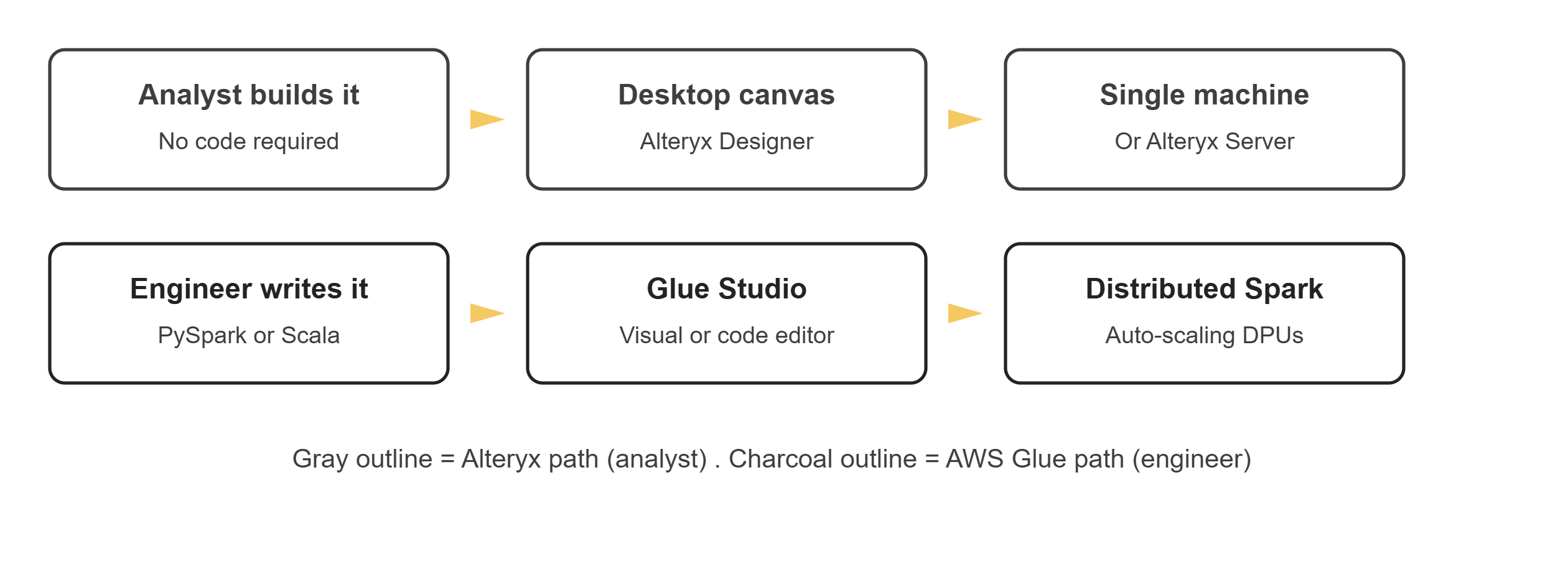
The two platforms solve the same problem with almost opposite operating models. In Alteryx, an analyst builds a workflow visually, with no code, and runs it on their own machine or on Alteryx Server. On AWS Glue, an engineer writes the pipeline in PySpark, often starting in Glue Studio's visual editor, and the job runs across a distributed, auto-scaling pool of Spark workers. Neither path is a lesser version of the other; they're built for different people solving the same problem at different scales.
Alteryx is architecturally desktop-centric. A Designer workflow runs on the analyst's machine (or Alteryx Server for scheduled/shared execution), processing data through an in-memory engine optimized for a single node. Fast and interactive for small-to-medium datasets, but scale is bounded by the capacity of the machine or Server tier you provision.
AWS Glue is cloud-native and distributed by design. Jobs run on Apache Spark across a pool of Data Processing Units (DPUs) that AWS provisions, scales, and tears down automatically. One DPU provides 4 vCPUs and 16 GB of memory, and Glue 4.0 auto-scaling adds or removes workers based on workload. No cluster to manage, nothing running when a job is idle.
Cost Model: Fixed Seats vs. Pay-Per-Second
This is the sharpest divide. Alteryx is a fixed, per-seat annual cost; you pay for each named user whether they run one workflow a month or a thousand. AWS Glue is purely consumption-based: $0.44 per DPU-hour, billed per second with a one-minute minimum, and $0 when nothing is running. For a small team of heavy daily users, Alteryx's fixed cost can be predictable and even economical. For bursty, large-scale, or infrequent workloads, Glue's elasticity usually wins on total cost of ownership. This same cost-governance discipline- right-sizing DPUs, tuning worker allocation, avoiding idle spend- is exactly what our AWS Glue ETL Consulting Services team builds into every engagement from day one.
Ease of Use: Code-Free vs. Code-Required
Alteryx is the clear winner for non-technical users. Its visual canvas lets an analyst assemble a working pipeline in an afternoon, abstracting away code entirely. AWS Glue, despite its visual editor, Glue Studio, expects familiarity with PySpark, partitioning, and the AWS console. The trade-off is control: what Glue asks in skill, it repays in flexibility and reproducibility.
Governance: Whose Stack Do You Inherit?
Alteryx Server centralizes scheduling, versioning, and access control for teams and supports enterprise certifications such as HIPAA, SOC 1/2, and GDPR. AWS Glue inherits the full AWS governance stack: IAM for fine-grained permissions, Lake Formation for row- and column-level governance, CloudTrail for auditing, and the Glue Data Catalog as a single source of metadata truth across all AWS analytics services. For organizations already standardized on AWS, Glue's governance is deeper and more unified. Our own AWS Glue ETL Consulting Services practice builds pipelines directly on this governance stack.
When to Choose Alteryx, and When to Choose AWS Glue
Choose Alteryx when:
- Business analysts, not engineers, own the data prep and need to self-serve.
- Speed-to-insight matters more than infrastructure costs, and datasets are small to medium in size.
- Workflows blend spreadsheets, spatial data, and light predictive modeling on a single canvas.
- The team lacks Spark/Python skills and values a code-optional experience.
Choose AWS Glue when:
- You're building production pipelines at terabyte scale inside AWS.
- Workloads are bursty or scheduled, so paying only for compute consumed is a real saving.
- Native integration with S3, Redshift, Athena, and Lambda is central to the architecture.
- Engineering wants version-controlled, reproducible ETL as code rather than desktop artifacts.
If your organization is standardized on Microsoft instead of AWS, the equivalent decision looks different. Our Alteryx to Microsoft Fabric Migration piece covers that specific target platform and its own trade-offs.
Real Pricing Numbers: Per-Seat vs. Pay-Per-Second
The two tools are almost impossible to compare on a single number because they bill on different axes: people versus compute. This table reframes each cost driver so you can map it to your own workload.
| Cost Driver | Alteryx (per-seat) | AWS Glue (serverless) |
|---|---|---|
| Unit of billing | Named user, per year | DPU-hour ($0.44), per second |
| List entry point | ~$5,195/user/yr (Designer); Designer Cloud Pro ~$4,950/user/yr, 3-user min | No entry fee; ~$0.88/hr minimum Spark job (2 DPUs) |
| Idle cost | Full price even if unused | $0 when no job runs |
| Typical deal size | Median ~$27K/yr; ranges ~$9K-$121K (per Vendr's tracked SaaS deal data) | Scales with data volume and job frequency |
| Hidden costs | Server licenses, add-ons, certification ($800-$2,500) | Crawlers, Data Catalog above free tier, S3/Redshift, DataBrew |
| Cost optimization | Limit seats; hybrid Python for technical staff | Glue 4.0 auto-scaling (30-50% savings), Flex execution, Python Shell for light jobs |
| Best economics | Small team of daily heavy users | Large-scale, bursty, or infrequent workloads |
Worked example (Glue): a job using 6 DPUs for 15 minutes costs 6 × 0.25hr × $0.44 = $0.66. The Data Catalog is free up to 1 million objects and 1 million requests per month. A lightweight Python Shell task can run on as little as 1/32 of a DPU, roughly $0.003 per hour, a fraction of a full Spark job. Rule of thumb: Alteryx cost is a function of headcount; Glue cost is a function of how much data you move and how efficiently your Spark jobs are written.
How to Migrate from Alteryx to AWS Glue, Step by Step
Migrating is not a lift-and-shift; Alteryx workflows do not have a direct import into Glue. Each workflow is re-expressed in PySpark. A disciplined, phased approach keeps the rewrite accurate and auditable:
- Assess and inventory. Catalog every Alteryx workflow, its tools, inputs, outputs, and dependencies. Score each by complexity to sequence the work and estimate effort.
- Map tools to PySpark equivalents. Translate each Alteryx tool- Join, Summarize, Formula, Filter, Sort, Multi-Row- to its Spark/PySpark pattern. Edge cases (Alteryx's round-half-away-from-zero rounding, Sort→Summarize semantics) need explicit handling to preserve exact outputs. Our Alteryx to AWS Glue ETL Migration page covers this tool-by-tool mapping in more depth.
- Rebuild extraction via the Data Catalog. Point Glue at S3, Redshift, or relational sources; use crawlers or manual table definitions to register schema.
- Re-author transformations as Glue jobs. Implement the mapped logic in PySpark, parameterized for incremental and full loads, with orchestration via Glue Workflows or AWS Lambda.
- Validate parity. Run automated value-verification comparing Glue output against the original Alteryx results, row-by-row and column-by-column, before cutover. Our Alteryx to PySpark Migration piece covers exactly this platform-behavior validation work in depth.
- Optimize and operationalize. Tune partitioning and DPU allocation, enable auto-scaling, and add monitoring, alerting, and job-lock controls for production reliability. Our ETL Migration Solutions practice runs this same optimize-and-operationalize phase across every platform migration, not just this one.
Common migration challenges:
- Numeric fidelity: Alteryx's rounding and aggregation semantics must be reproduced exactly in Spark.
- Connectivity: on-premises sources may be unreachable from the Glue VPC; pre-staging data to S3 is a proven workaround.
- Skill shift: teams move from a visual canvas to code, so reusable PySpark patterns and templates accelerate delivery.
- Data type mapping: source (e.g., Redshift) types must be cast correctly to Spark types to avoid silent nulls.
FAQ
Planning an Alteryx-to-AWS Glue Migration?
DataTerrain has migrated 27,000+ reports and workflows across 400+ customers in 17+ years. Our automated assessment inventories your Alteryx workflows, maps them to validated PySpark patterns, and delivers production-ready Glue pipelines with output-parity testing.
Talk to a DataTerrain ETL Specialist →
References
Related Migration Resources
Alteryx to AWS Glue ETL Migration | Alteryx to PySpark Migration | AWS Glue ETL Consulting Services | ETL Migration Solutions | Alteryx to Microsoft Fabric Migration