Contents
- 24 Sep 2026
Tableau Consulting Companies: Services, How to Choose, and What to Expect
Businesses rely on data to make faster and more informed decisions, but extracting meaningful insights requires more than just a powerful analytics platform. Tableau consulting companies help organizations implement, optimize, govern, and scale Tableau across enterprise environments by aligning dashboards, data models, and governance frameworks with business objectives. Whether you're deploying Tableau for the first time, migrating from another BI platform, or improving an existing analytics environment, choosing the right consulting partner can significantly improve performance, user adoption, and long-term return on investment. This guide explains the services Tableau consulting companies provide, how to evaluate the right partner, and the key factors that contribute to a successful Tableau implementation.

- Share Post:
-

-

What Is Tableau and Why Do Businesses Need Tableau Consulting Services?
Tableau is an enterprise analytics platform that connects to virtually any data source and transforms raw data into interactive dashboards, governed reports, and AI-generated insights via Tableau Pulse. It sits at the consumption layer of the BI stack, above your data warehouse, ETL pipelines, and semantic layer.
Done well, Tableau becomes a governed source of truth that scales to thousands of concurrent users. Done poorly, the result is conflicting workbooks, slow dashboards, and a license bill that cannot be justified.
What Do Tableau Consulting Services Include?
Decisions made early in each layer determine platform cost and performance for years.
Architecture and Deployment: Node topology sizing (VizQL Server, Backgrounder, Data Engine), Tableau Server versus Tableau Cloud selection, SAML 2.0/OIDC/Kerberos authentication, and Tableau Bridge setup for on-premises source connectivity. Tableau Server architecture decisions at this stage govern platform cost and scalability.
Data Preparation and Extract Strategy: Tableau consulting companies help organizations design efficient Hyper extracts, configure extract scheduling, and optimize live connections with Snowflake, Google BigQuery, Amazon Redshift, Microsoft Fabric, and other cloud data platforms. Proper extract strategies improve dashboard performance while reducing infrastructure costs.
Semantic Layer and Certified Data Sources: Metrics, KPIs, and business logic are defined once in Tableau Data Server and published centrally, so every workbook inherits consistent definitions instead of embedding its own SQL. This is the foundation of data governance and a prerequisite for Tableau Pulse.
Tableau Data Modeling, Dashboard Development, and Tuning: Dashboard development against governed data sources, performance-profiled before delivery. Dashboard tuning and dashboard consolidation without breaking downstream workbooks are among the most common requests organizations bring to Tableau consulting firms.
Governance, Row-Level Security, and License Management: Attribute-based RLS via SAML or OIDC enforced at the virtual connection layer. Site role auditing to reduce license cost. Content lifecycle management to retire stale workbooks.
The Tableau Maturity Journey
The Tableau Maturity Journey illustrates the four stages organizations progress through when adopting Tableau, from basic dashboards to AI-augmented analytics. It highlights how strong data governance at the governed self-service stage creates the foundation for scalable, enterprise-wide analytics and AI-driven insights.
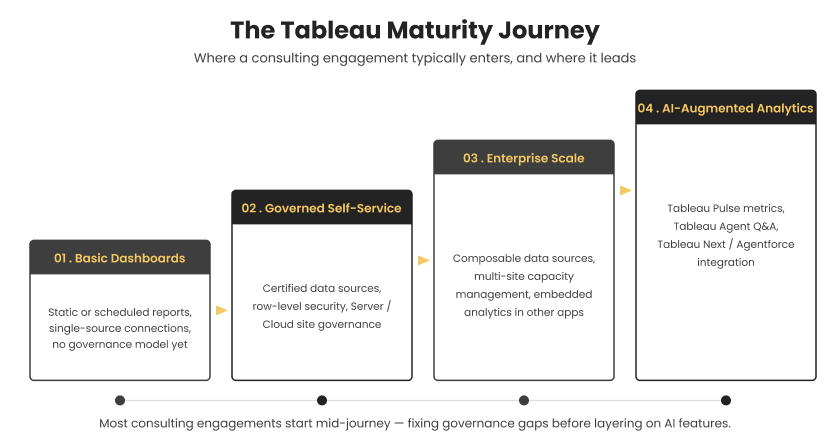
Figure 1. The Tableau Maturity Journey: From Basic Dashboards to AI-Augmented Analytics
Skipping straight to Stage 4 without Stage 2's governance in place is the single most common mistake - Tableau Pulse surfacing AI-generated summaries from ungoverned, uncertified data sources just produces confident, fast, wrong answers faster than a human ever could.
How to Select the Right Tableau Consulting Company
The market spans boutique firms, global systems integrators, and specialist consultancies. These criteria separate the best Tableau consulting partners from underprepared ones.
Tableau Certifications: Verify the team holds active Tableau Desktop Certified Professional and Tableau Server Certified Professional credentials. These are verifiable through Salesforce's official Tableau partner directory.
Cloud and Data Stack Expertise: Proven integration experience with Snowflake, AWS Redshift, Google BigQuery, and Microsoft Fabric, with query pushdown configured correctly from day one.
Vertical and Industry Experience: Healthcare, financial services, and retail each carry distinct KPI frameworks and compliance requirements. Vertical experience eliminates ramp time and rework.
BI Migration Tooling: Automation tooling for migration from Power BI, OBIEE, BusinessObjects, IBM Cognos, Crystal Reports, or Hyperion. Manual migration dramatically increases timeline and risk.
Governance-First Methodology: The semantic layer must be designed before any dashboards are built. Ask directly: when in the engagement does semantic layer design occur?
The Tableau Consulting Process
A structured engagement follows four phases, each building on the previous to deliver a governed, high-performance Tableau environment.
Environment Assessment
Review existing reports, dashboards, infrastructure, and data sources to identify performance bottlenecks, duplicate content, conflicting metric definitions, unused assets, and governance gaps before implementation begins.
Architecture and Semantic Layer Design
Define warehouse connectivity, authentication, extract strategy, certified data sources, and row-level security before dashboard development starts.
Dashboard Development and Migration
Build dashboards using governed data sources and migrate reports from legacy BI platforms, with automated source-to-target reconciliation before cutover.
Governance, Optimization, and Knowledge Transfer
Optimize performance, establish governance policies, audit user roles, document the environment, provide administrator and end-user training, and transfer knowledge to enable internal teams to confidently manage Tableau.
Why Businesses Struggle with Tableau Without Expert Consulting
Most Tableau implementation failures share the same root causes.
Wrong Extract Strategy: Live connections that should be extracts, or oversized extracts that time out for business users. Correct extract design is a Tableau data modeling discipline, not a checkbox.
No Semantic Layer: Every team defines revenue or headcount its own way. When those definitions disagree, the argument begins, and nobody can resolve it because no single definition has ever been certified.
Row-Level Security Managed Per Workbook: Fragile and breaks silently when a workbook is duplicated. All downstream content inherits security at the virtual connection layer.
License Over-Provisioning: Assigning Creator licenses to Viewer-only users is the most expensive routine mistake in a Tableau estate.
Dashboard Sprawl: Without governance and content lifecycle management, organizations accumulate hundreds of dashboards and workbooks over time. Removing outdated content and maintaining a single source of truth improves adoption, performance, and user trust.
Tableau vs Other BI Tools: Where Tableau Consulting Firms Add Unique Value
The right BI platform depends on where your data lives, your team's analytical skills, and your governance requirements.
| Dimension | Tableau | Power BI | OBIEE / Oracle Analytics Cloud |
|---|---|---|---|
| Visualisation | Best-in-class interactive and exploratory analytics | Strong; improving with Copilot | Operational and pixel-perfect reporting |
| Semantic Layer | Tableau Semantics + certified data sources + Tableau Pulse | Power BI semantic model; Copilot integration | RPD-based; strong for Oracle platforms |
| Cloud Integration | Native connectors for Snowflake, BigQuery, Redshift, Fabric; query pushdown | Deep Azure/Fabric integration; DirectQuery | Strong Oracle Cloud and on-premises connectivity |
| Best Fit | Diverse data, strong self-service, complex visual analytics | Microsoft / Azure / Office 365 organizations | Oracle ERP/HCM environments |
Tableau's competitive advantage is its visualization depth, a mature semantic layer, and the Tableau Pulse agentic layer, making it the strongest choice for governed self-service analytics and interactive data visualization at enterprise scale.
How DataTerrain Delivers Tableau Consulting Services
DataTerrain Tableau consulting addresses the four problems that stall most implementations: ungoverned semantic layers, poor extract design, per-workbook RLS, and unreconciled migrations.
Semantic Layer Design First: Business logic is defined in Tableau Data Server before any dashboard is built. Certified data sources govern every downstream workbook rather than being retrofitted.
Performance Diagnosis at the Query Level: Slow estates are profiled at the extract and VizQL query level. Query pushdown resolves the actual bottleneck.
Migration Tooling and Source-to-Target Reconciliation: Automated migration from Power BI, OBIEE, BusinessObjects, Crystal Reports, IBM Cognos, and Hyperion with full source-to-target reconciliation before the legacy platform is switched off.
Hybrid and Multi-Cloud Connectivity: DataTerrain supports hybrid and multi-cloud environments by integrating Tableau Cloud with on-premises systems via Tableau Bridge, virtual connections, and secure extract scheduling, enabling seamless enterprise deployments.
Governance and Content Lifecycle Management: Row-level security at the connection layer, site role auditing to reduce license cost, and usage telemetry to retire stale workbooks.
Tableau Training and User Adoption: DataTerrain's Tableau consulting extends beyond implementation. Administrator training, end-user enablement, documentation, and knowledge transfer help teams confidently build dashboards, interpret insights, and maximize long-term Tableau adoption and ROI.
Ready to Get More From Your Tableau Investment?
DataTerrain delivers Tableau consulting across architecture, semantic layer design, migration, and ongoing optimization, with and no need for access to your production systems.
Request a Free Tableau AssessmentKey Takeaways
- Tableau consulting companies help organizations implement, optimize, govern, and scale Tableau for enterprise analytics.
- A successful Tableau implementation begins with a well-designed semantic layer, data governance strategy, and optimized extract architecture.
- Look for consulting partners with certified Tableau professionals, cloud integration expertise, migration automation capabilities, and industry-specific experience.
- Enterprise deployments benefit from robust security, row-level access controls, performance optimization, and content lifecycle management.
- Automated migration and source-to-target reconciliation reduce project risks when transitioning from legacy BI platforms such as Power BI, OBIEE, BusinessObjects, IBM Cognos, and Crystal Reports.
- Ongoing training, user adoption programs, and governance help organizations maximize long-term value from their Tableau investment.
- Choosing an experienced Tableau consulting company enables businesses to build scalable, high-performing analytics solutions that support better decision-making.
Conclusion
Selecting the right Tableau consulting company is about more than deploying dashboards; it's about building a scalable analytics environment that delivers consistent, trusted insights across the enterprise. From architecture planning and semantic layer design to governance, performance optimization, and BI migration, experienced Tableau consultants help organizations reduce risk, improve adoption, and maximize long-term ROI. Whether you're implementing Tableau for the first time, modernizing an existing deployment, or migrating from another BI platform, choosing a partner with proven enterprise expertise, automation capabilities, and a governance-first methodology will ensure your Tableau investment continues to deliver measurable business value.
References
Tableau Server Official Documentation | Tableau Server vs Tableau Cloud
Frequently Asked Questions
Related Articles
Tableau Server Management for Scalable Enterprise Deployments | Tableau New Features | Expert Tableau Consulting Services | Data Extraction in Tableau | Tableau Product Suite Guide