Contents
- 01 Sep 2026
Crystal Reports to Jaspersoft Migration: Automated Conversion That Preserves Your Reports
Migrating from Crystal Reports to Jaspersoft doesn't have to mean rebuilding your reporting estate from scratch. DataTerrain's automated conversion tool translates Crystal Reports directly into Jaspersoft's native JRXML format, preserving report layouts, embedded formulas, and native functions, so years of report design work carry forward instead of getting thrown away.

- Share Post:
-

-

Quick Summary
DataTerrain's Crystal Reports to Jaspersoft migration runs through a proprietary automation tool that maps Crystal Reports to .ttx files, generates per-report XML configuration, and converts each report directly into Jaspersoft's JRXML format, translating embedded formulas and native functions along the way. This isn't a one-off tool; it's been refined across real engagements totaling 27,000+ reports migrated for 400+ enterprise clients over 17+ years. With SAP Crystal Reports 2020 losing mainstream maintenance on December 31, 2026, this is a live, time-sensitive decision for many organizations.
At a Glance
- The industry-standard process runs five stages: Inventory Analysis, Conversion/Re-engineering, Parameter & Logic Mapping, Validation & Testing, and Deployment, confirmed by Jaspersoft's own migration guidance.
- AI-powered conversion is now an emerging option too. Jaspersoft Community documented an agent-powered workflow (June 2026) that analyzes exported Crystal Report metadata and automatically generates JasperReports artifacts, alongside traditional automated tooling.
- Parameter mapping is where logic actually lives, recreating filters and formulas like start and end date ranges inside Jaspersoft, not just moving layout.
- Parallel testing is the validation standard: running original Crystal Reports output against newly generated Jaspersoft results side by side to confirm data integrity before cutover.
- DataTerrain's own automation has been refined across 27,000+ reports for 400+ enterprise clients, spanning everything from a Canadian provincial government to enterprise clients with complex multi-database report estates.
Why Migrate from Crystal Reports to Jaspersoft?
Organizations move off Crystal Reports for a mix of reasons that tend to compound over time: escalating per-seat licensing costs, a shrinking pool of developers with real Crystal Reports expertise, and, increasingly, the approaching end-of-support deadlines for Crystal Reports 2020 and 2025. Jaspersoft offers an open-source foundation, more flexible licensing, and active development, without asking organizations to abandon years of report design investment to get there. For a broader look at Jaspersoft's own capabilities beyond just being a Crystal Reports replacement, see our Jaspersoft Reporting Tool overview.
Crystal Reports vs. Jaspersoft: Architecture Comparison
| Element | Crystal Reports | Jaspersoft (JRXML) |
|---|---|---|
| Layout structure | Sections | Bands |
| Report format | .rpt | .jrxml |
| Formula language | Crystal Syntax / Basic Syntax | JRXML expressions (Java-based) |
| Parameters | Crystal parameter fields | $P{} parameters |
| Grouping | Group headers/footers | Group bands |
| Cross-tabs | Cross-Tab object | Crosstab element |
| Subreports | Linked subreports | Embedded JRXML subreports |
| Charts | Crystal charting engine | JRXML chart elements |
| Database connections | Crystal Reports connection objects | JRXML data source references |
The Five-Stage Migration Process
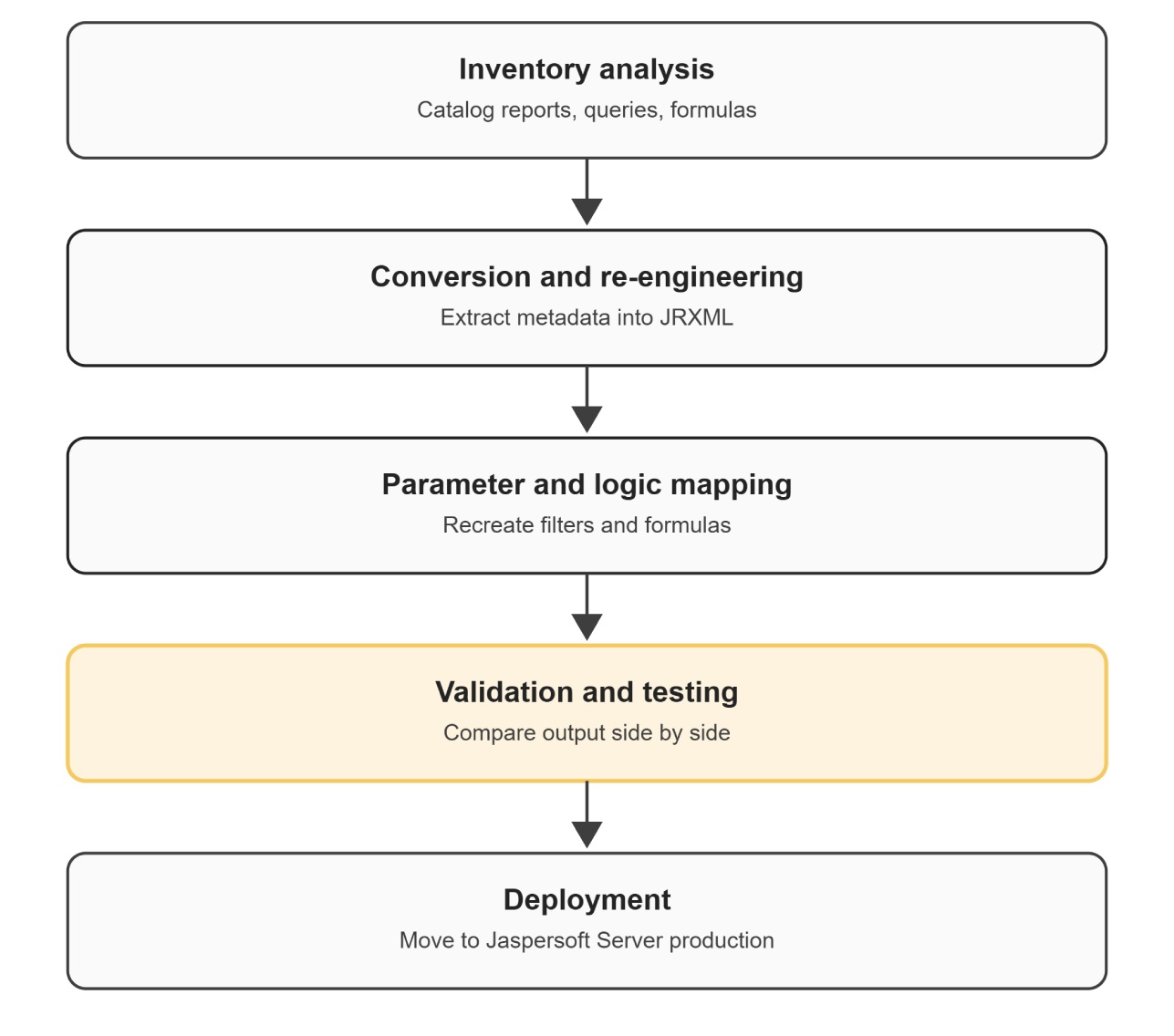
Figure: Inventory Analysis → Conversion and Re-engineering → Parameter and Logic Mapping → Validation and Testing → Deployment
This process is consistent across the industry, and it's the same structure DataTerrain's automation tool follows:
- Inventory analysis: catalog all active reports, database connections, SQL queries, formulas, parameters, and subreports before touching anything.
- Conversion and re-engineering: extract metadata from .rpt files and translate layouts into Jaspersoft-compatible JRXML, using automated tools or Jaspersoft Studio.
- Parameter and logic mapping: recreate filters, formulas, and parameters; common examples include start and end date ranges, within the Jaspersoft environment.
- Validation and testing: run parallel tests, comparing original Crystal Reports output against newly generated Jaspersoft results to confirm data integrity.
- Deployment: move validated .jrxml templates to your Jaspersoft Server production environment.
How DataTerrain's Automated Conversion Works
DataTerrain's conversion tool handles the mechanical, error-prone parts of migration so the engagement can focus on validation and edge cases rather than manual re-authoring:
- Crystal Reports mapping. Each report is mapped to a corresponding .ttx file, with field names adjusted as needed to align with the Jaspersoft target structure.
- XML configuration generation. A dedicated XML config file is created for every report, ensuring it executes correctly inside the Jaspersoft environment.
- Report analysis and gap detection. The tool examines every element in the source report, identifies anything missing or incompatible, and generates a detailed log pinpointing exactly where attention is needed, rather than a generic error message.
- Formula and native function conversion. Complex formula logic and native Crystal Reports functions are translated into equivalent Jaspersoft implementations, preserving the business logic embedded in the original reports, not just the visual layout.
- Batch or single-file processing. Reports can be converted individually or as a full folder at once, which matters when migrating a large estate rather than a handful of reports.
What This Solves That Manual Migration Doesn't
Manually rebuilding a Crystal Reports estate in Jaspersoft means re-authoring every report from scratch- layout, data connections, and formula logic- with no guarantee the result behaves identically to the original. DataTerrain's approach preserves the design investment already made: the report sections, layouts, and business logic your organization built over years aren't discarded and rebuilt; they're translated and validated.
Real Results at Scale
This isn't a theoretical process. DataTerrain has migrated 27,000+ reports for 400+ enterprise clients using this same automated methodology, including:
- Crystal Reports to Jaspersoft, 67 Reports, Zero Errors: a leading insurance provider's full report estate migrated across multiple servers and databases with output parity confirmed report by report.
- Crystal Reports to Jaspersoft Migration: A BI Success Story: KPI dashboards and reporting supporting 86,000 product lines across 14+ countries for a workplace solutions provider.
- A Canadian provincial government engagement, where DataTerrain conducted extensive presentations and proofs of concept to demonstrate seamless migration, prioritizing preservation of the familiar GUI government staff already depended on, while meeting strict data privacy and security requirements.
Planning Around the Crystal Reports Deadline
SAP Crystal Reports 2020 loses mainstream maintenance on December 31, 2026, with Crystal Reports 2025 following on December 31, 2027. After those dates, security patches, bug fixes, and compatibility updates stop. Reports keep running until something breaks, with no vendor support left to fix it. For the complete deadline breakdown, what "end of mainstream maintenance" actually means for your reports, and how to plan a realistic migration window, see our dedicated SAP Crystal Reports End of Life piece.
How DataTerrain Helps
DataTerrain's automation tool and technical team preserve years of report design effort during migration, converting native functions and complex formula logic into equivalent Jaspersoft implementations while keeping the reporting structures your teams already know. We offer a complimentary analysis of a sample set of your Crystal Reports and metadata, plus a real-time demo of the conversion framework, before you commit to a full engagement.
Ready to Migrate Your Crystal Reports to Jaspersoft?