- 21 July 2026
Enterprise Cloud Migration Platform for Large-Scale Modernization
An enterprise cloud migration platform is a structured, automation-driven system that manages the end-to-end movement of legacy infrastructure, data, and BI environments to the cloud. It coordinates automated discovery, dependency mapping, cloud migration strategy execution, data integrity validation, and embedded governance controls throughout the full legacy infrastructure modernization lifecycle across AWS, Azure, and GCP.
Most enterprise cloud modernization programs fail not because the target platform is wrong but because the migration is treated as a lift-and-shift exercise rather than an engineered process. Dependencies get missed, governance gets added after the fact, and validation occurs too late to catch problems before they reach production. The organizations that succeed treat cloud migration assessment as the foundation, not a formality.
DataTerrain has powered 400+ enterprise modernization engagements across healthcare, HR/HCM, and financial services, organizations with deeply interconnected legacy systems, tightly coupled workload migration requirements, and compliance-ready migration obligations that cannot tolerate guesswork during a transition.

- Share Post:
-

-

What an Enterprise Cloud Migration Platform Actually Does
More than a set of cloud migration tools, a platform built for large-scale cloud native transformation handles four capabilities in a coordinated way:
| Capability | What It Solves |
|---|---|
| Automated discovery and dependency mapping | Surfaces hidden dependencies between legacy applications, data pipelines, and BI reports before migration starts |
| Cloud migration strategy execution | Runs big bang, phased, or CDC-based migrations depending on downtime tolerance |
| Validation and reconciliation | Proves data and business logic transferred correctly, not just that the job completed |
| Embedded governance | Enforces identity, access, and audit controls throughout migration, not as a post-migration cleanup |
How DataTerrain's Enterprise Cloud Migration Platform Works
DataTerrain's enterprise cloud migration platform executes legacy infrastructure modernization in five coordinated steps, from initial assessment through a governed cutover to the consistency of multi-cloud migration.
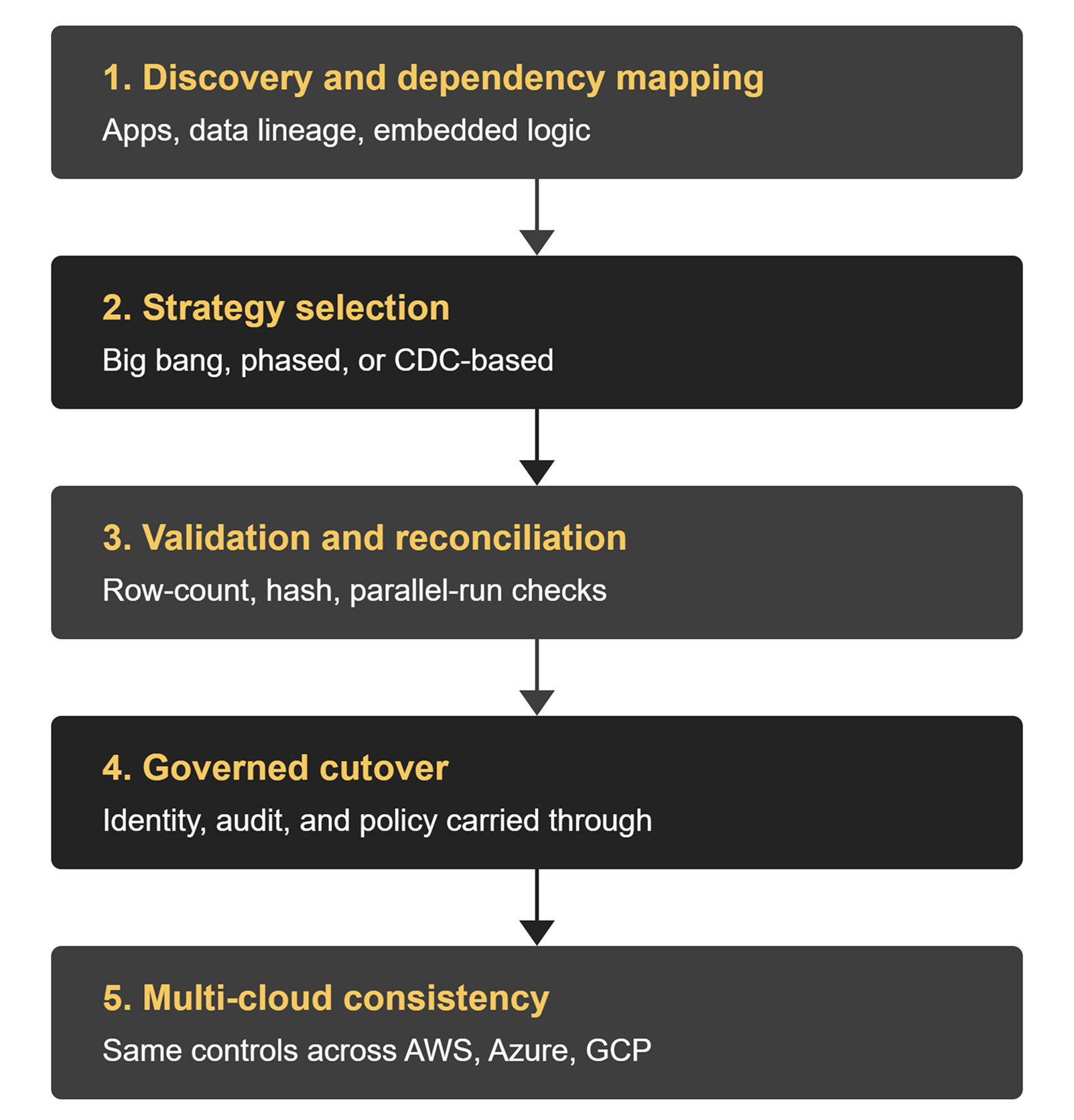
Figure 1. DataTerrain's 5-step cloud migration methodology.
Step 1 — Discovery and Dependency Mapping
Enterprise environments accumulate years of incremental changes, mergers, and system extensions. Running a cloud migration assessment without a full baseline turns simple migrations into multi-month firefights.
DataTerrain's automated discovery engine maps:
- Application and workload dependencies — what talks to what and in what order it needs to move
- Data lineage — where data originates, how it is transformed, and everywhere it is consumed downstream
- Embedded business logic — calculations, transformation rules, and reporting definitions buried in legacy scripts, ETL jobs, and BI semantic layers
- Brittle and undocumented dependencies — the highest-risk element of any migration risk management program, typically the scripts and integrations nobody remembers building.
This baseline turns cloud migration planning from an assumption-driven exercise into a data-driven one.
Step 2 — Cloud Migration Strategy Selection
Not every workload should move the same way. DataTerrain supports three cloud migration strategy approaches selected per workload based on downtime tolerance and criticality:
| Strategy | How It Works | Best For |
|---|---|---|
| Big Bang | Full cutover in a scheduled maintenance window | Smaller, self-contained workloads with acceptable downtime |
| Phased Migration | Migrate by business unit, workload, or geography in sequential waves | Large, complex portfolios where a single cutover is too risky |
| CDC-Based Migration | Continuous replication via change data capture, near-zero-downtime cutover | Mission-critical, always-on systems that cannot go dark |
For hybrid cloud migration transitions where not everything moves in a single phase, the platform maintains routing and performance consistency across on-premises and cloud environments, ensuring users and downstream systems are not disrupted during the migration.
Step 3 — Validation and Reconciliation
This is where most cloud migration execution efforts fall short. Declaring success because nothing crashed, without proving data and logic are correct, is not validation.
DataTerrain enforces validation at every layer:
- Row-count validation — confirms every record moved, table by table
- Hash and checksum validation — detects silent data corruption including truncated decimals, shifted timestamps, and dropped precision, invisible to row counts alone
- Functional reconciliation — compares application behavior and report output between pre-migration and post-migration states
- Parallel run testing — both environments run simultaneously so business owners sign off on real live output before zero downtime migration cutover, not a demo environment
Defects get caught during migration, not discovered by a business user three weeks after go-live.
Step 4 — Governance Built In, Not Bolted On
For regulated industries, security governance cannot be an afterthought applied only once systems are in the cloud. DataTerrain embeds governance controls throughout the migration lifecycle:
- Identity and access management — consistent access controls carried through from legacy to cloud, not reconfigured from scratch post-migration
- Audit trails — every migration decision, data movement, and configuration change is logged and traceable
- Policy enforcement — data-handling and security policies remain intact and verifiable throughout the transition
- Compliance-ready documentation — built for HIPAA, SOX, and OFCCP frameworks where auditors need to see controls, not just outcomes
Step 5 — Multi-Cloud Consistency
Enterprises increasingly run on multiple cloud providers to meet regulatory, performance, or geographic data residency requirements. DataTerrain's multi-cloud migration logic, validation processes, and governance policies remain consistent across AWS, Azure, and GCP so environments do not end up with fragmented controls depending on which team migrated which workload.
Automated Conversion Engine
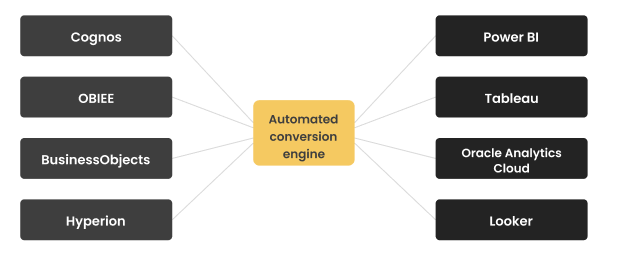
Figure 1. DataTerrain's automated conversion engine translates legacy BI platforms directly into modern analytics targets.
DataTerrain's automated conversion engine handles the full BI migration stack. Source platforms including Cognos, OBIEE, BusinessObjects, and Hyperion are converted directly to Power BI, Tableau, Oracle Analytics Cloud, and Looker through automated metadata extraction, logic conversion, and output validation. No manual rebuilding required.
Business Outcomes
| Platform Capability | Business Outcome |
|---|---|
| Automated dependency mapping | Fewer surprise outages from missed dependencies |
| Phased and CDC cloud migration strategy | Migration downtime matches actual business risk tolerance |
| Hash and row-count validation | Data integrity proven, not assumed |
| Parallel-run sign-off | Business stakeholders trust the new environment on day one |
| Embedded security governance | Compliance review becomes a formality, not a scramble |
| Multi-cloud migration consistency | No fragmented controls across AWS, Azure, or GCP |
Customer Story — Fortune 50 Manufacturer: SAP BusinessObjects to OBIEE
A global Fortune 50 manufacturer in construction, mining, energy, and transportation equipment needed to migrate its entire Taleo reporting environment from SAP BusinessObjects to OBIEE across multiple international locations. The engagement had a hard end-of-support deadline with zero tolerance for business disruption, a compliance-ready migration requirement common in regulated enterprise environments.
DataTerrain executed the migration in three phases: automated AS-IS assessment and dependency mapping, automated legacy infrastructure modernization with metadata conversion, and stakeholder-led user acceptance and rollout.
Results delivered:
- On time — completed before BusinessObjects support ended
- On budget — no cost overruns on a global enterprise engagement
- Zero business disruption — recruiting and compliance reporting ran uninterrupted throughout
- 100% report logic preserved — look, feel, and business logic carried forward exactly with minimal retraining
Why Enterprises Choose DataTerrain
- Faster time-to-value. Automation-led discovery and conversion mean most migrations complete in months, not years, realizing cloud adoption benefits sooner.
- Lower total migration risk. Every dataset is validated through row-count checks, hash and checksum comparison, and functional reconciliation before go-live. No surprises after cutover.
- Reduced long-term maintenance cost. Report rationalization typically reduces legacy portfolios by 20 to 40 percent before migration begins, so organizations enter their new platform with less to maintain.
- Compliance stays intact, not reconstructed. For healthcare, HR/HCM, and financial services clients, governance carries over during migration rather than being rebuilt from scratch afterward. HIPAA, SOX, and OFCCP compliance posture never has a gap.
- No forced downtime around your business calendar. CDC-based and phased strategies mean reporting environments do not go dark for a migration weekend. Operations continue while the transition happens in the background.
- Proof, not promises, at go-live. Business stakeholders sign off on parallel run testing before cutover, so the people who actually use the reports trust the new system from day one.
Summary
- An enterprise cloud migration platform coordinates automated discovery, cloud migration strategy execution, validation, and governance across legacy infrastructure, data, and BI environments.
- Most enterprise cloud modernization programs fail due to insufficient validation and overlooked dependencies in workload migration, not because the target platform is wrong.
- DataTerrain has powered 400+ migrations across healthcare, HR/HCM, and financial services
- Three cloud migration strategy options supported: big bang, phased, and CDC-based for zero downtime migration
- Validation covers row count, hash and checksum, functional reconciliation, and parallel-run testing before go-live.
- Security governance including identity, access, audit trails, and policy enforcement is embedded throughout migration, not added after
- Multi-cloud migration support across AWS, Azure, and GCP maintains consistent controls across providers.
- Report rationalization reduces legacy portfolios by 20-40% before migration begins.
- Compliance-ready migration documentation produced for every conversion decision, built for HIPAA, SOX, and OFCCP
Frequently Asked Questions
Related Reading
Cloud Migration Services — Future-Ready BI | Automated Data Center Migration Framework | Cloud Migration Engineering Services Automation | Migrate SAP Business Objects with DataTerrain Automation