- 22 July 2026
Automated Data Center Migration Framework for Enterprise Modernization
An automated data center migration framework is a repeatable enterprise methodology that uses automated discovery, application dependency mapping, workload orchestration, and migration validation to move infrastructure, applications, databases, and reporting systems to a new data center or cloud environment with minimal downtime and proven data integrity.
Most enterprise data center migration projects are not simply server moves. Organizations are untangling years of interconnected workloads, legacy integrations, distributed storage, and BI environments that often depend on infrastructure nobody fully documented. A structured framework transforms that complexity into a governed, automation-driven modernization program.

- Share Post:
-

-

Why Enterprises Need an Automated Data Center Migration Framework
Large organizations typically face one or more of these modernization scenarios:
- Consolidating multiple data centers into fewer facilities
- Performing data center migration to cloud environments
- Modernizing aging VMware or physical server infrastructure
- Standardizing configurations across multi-region environments
- Preserving compliance and audit continuity during migration
- Migrating BI and reporting systems that are tightly coupled to existing infrastructure
The challenge is not simply moving data. The challenge is to preserve application behavior, reporting accuracy, security controls, and business continuity as the underlying infrastructure changes.
Why Manual Data Center Migration Fails at Enterprise Scale
- Undocumented Dependencies - The highest-risk integrations are often the ones nobody remembers building.
- Configuration Drift - Small differences between environments accumulate over the years and become points of failure in migration.
- Reporting Disruption - BI systems frequently depend on databases, file shares, ETL jobs, and network paths that change during infrastructure migration.
- Validation Bottlenecks - Manual data checks do not scale beyond a few hundred workloads.
- Compliance Gaps - Recreating access controls and audit trails after migration is where many compliance failures originate.
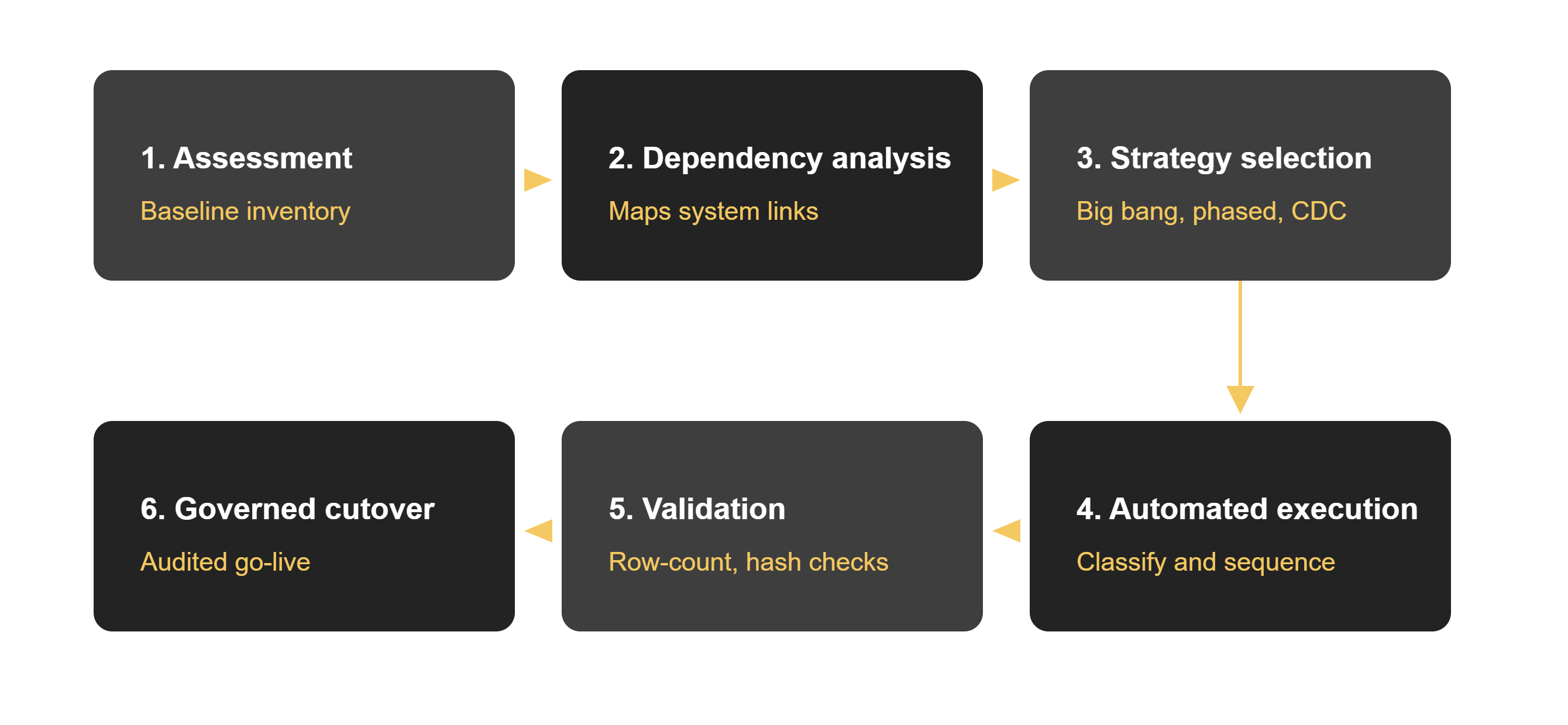
The Six-Step Enterprise Data Center Migration Framework
Successful enterprise data center migration requires a structured, repeatable process rather than isolated migration activities. The following six-step framework combines automated discovery, dependency analysis, migration execution, validation, and governance to reduce project risk while improving migration speed and accuracy.
Step 1: Infrastructure Assessment and Migration Readiness
Automated discovery tools inventory:
- Compute assets
- Storage systems
- Network configurations
- Application dependencies
- Performance baselines
- Compliance requirements
This creates a factual migration baseline rather than relying on outdated spreadsheets or tribal knowledge.
Step 2: Application Dependency Mapping
Application dependency mapping identifies:
- Upstream and downstream application connections
- Database relationships
- API integrations
- Authentication dependencies
- Reporting and analytics data flows
Accurate dependency mapping prevents unexpected outages during enterprise data center migrations.
Step 3: Migration Strategy Selection
Different workloads require different approaches.
| Migration Approach | Best For |
|---|---|
| Big Bang | Small environments with acceptable downtime |
| Phased Migration | Large enterprises with interconnected systems |
| CDC-Based Migration | Mission-critical systems requiring near-zero downtime |
CDC-based migration continuously replicates changes from the source environment to the target environment, enabling near-zero-downtime migration for critical applications and databases.
Step 4: Automated Workload Migration
Automation standardizes:
- Environment provisioning
- Configuration deployment
- Workload sequencing
- Network policy application
- Security baseline enforcement
- Migration scheduling
This consistency allows organizations to migrate hundreds or thousands of workloads without the process varying across engineers or business units.
Step 5: Migration Validation and Reconciliation
A migration is not successful simply because systems start up. A reliable framework includes:
- Row-count validation to confirm all records moved
- Hash/checksum validation to detect silent corruption
- Functional testing to verify application behavior
- Parallel-run validation for critical business systems
These controls prove that the migrated environment is correct, not merely operational.
Step 6: Governed Cutover and Monitoring
Cutover includes:
- Predefined rollback procedures
- Change approval checkpoints
- Audit logging
- Performance monitoring
- Post-migration reconciliation
This is especially important in healthcare, financial services, and HR/HCM environments where auditors require evidence of controlled execution.
Figure 1: Six-Step Automated Enterprise Data Center Migration Framework illustrating assessment, dependency analysis, migration strategy selection, automated execution, validation, and governed cutover.
Automated BI Report Migration During Data Center Modernization
One of the most common enterprise mistakes is migrating infrastructure first and addressing reporting later.
Why BI Report Migration Must Happen in Parallel
Dashboards, scheduled reports, embedded analytics, and executive KPIs often depend on:
- Database connections
- ETL pipelines
- File-system paths
- Authentication services
- Legacy BI platform configurations
If these dependencies are not migrated and validated alongside infrastructure, organizations can experience an analytics blackout even when applications appear healthy.
Structured BI Report Migration Process
A mature framework includes:
- Report complexity assessment - classify reports as simple, complex, or ultra-complex.
- Automated BI report conversion - translate report metadata, calculations, filters, and formatting to the target BI platform.
- Unit testing - compare source and target report outputs.
- Integration testing - validate connectivity and query execution in the target environment.
- User acceptance testing - business users confirm functional equivalence before production rollout.
Oracle BI to Microsoft Fabric and Power BI Migration
Many enterprise data center migration projects also include Oracle BI Publisher, OBIEE, and the modernization of legacy reporting.
Whether the target platform is Microsoft Fabric, Power BI, Amazon QuickSight, Snowflake, Databricks, Tableau, or another analytics environment, DataTerrain adapts the migration approach to the customer's architecture, governance requirements, and business priorities.
DataTerrain uses automated BI conversion workflows to migrate reports, dashboards, calculations, filters, and scheduling logic to modern analytics platforms as part of the underlying infrastructure migration.
This parallel approach helps eliminate the traditional gap between infrastructure migration and analytics modernization by validating reporting functionality during the migration program rather than after cutover.
Enterprise Data Center Migration Checklist
Use this checklist before production cutover:
- Automated infrastructure inventory completed
- Application dependency mapping validated
- Migration strategy assigned per workload
- Target environment capacity confirmed
- Security and compliance controls replicated
- Data replication synchronized
- Row-count validation passed
- Hash/checksum validation passed
- BI reports converted and tested
- Rollback procedures documented
- Business stakeholder sign-off obtained
This checklist is a practical data center migration checklist for enterprise modernization programs.
Business Outcomes of an Automated Migration Framework
| Framework Capability | Business Outcome |
|---|---|
| Automated dependency mapping | Fewer surprise outages |
| Workload-specific strategy selection | Downtime aligned to business risk |
| Row-count and hash validation | Proven data integrity |
| Parallel BI report migration | Continuous analytics availability |
| Governed cutover | Faster compliance review |
| Repeatable automation | Consistent results at enterprise scale |
What to Expect from Data Center Migration Services
A qualified migration partner should provide:
- Automated Discovery - Comprehensive infrastructure and dependency assessment.
- Migration Factory Operations - Standardized execution across large workload volumes.
- Validation Frameworks - Row-level reconciliation, checksum validation, and functional testing.
- BI Modernization Expertise - Capability to convert and validate reports during the infrastructure migration.
- Compliance-Ready Governance - Documented controls, approvals, audit trails, and rollback procedures.
Frequently Asked Questions
Why Enterprises Choose DataTerrain
DataTerrain combines infrastructure migration automation with BI modernization in a single governed framework. Key differentiators include:
- Automation-first migration methodology
- 360+ enterprise modernization engagements
- Built-in row-count, hash, and parallel-run validation
- Parallel migration of reporting and analytics environments
- Controlled, audit-ready execution for regulated industries
Unlike traditional infrastructure-only migration vendors, DataTerrain treats reporting continuity as a core migration requirement, ensuring that applications, data, dashboards, and executive analytics remain validated throughout the modernization program.
Key Takeaways
- Automated data center migration frameworks provide a repeatable, enterprise-scale migration process.
- Application dependency mapping helps prevent unexpected outages during cutover.
- Phased and CDC-based migration approaches support controlled or near-zero-downtime migration.
- Row-count, checksum, and functional validation are essential for proving data integrity.
- BI and reporting systems should migrate in parallel with infrastructure to avoid analytics disruptions.
- Governed cutover with rollback and audit controls is critical for regulated enterprise environments.
The Bottom Line
Enterprise data center migration succeeds when automated discovery, application dependency mapping, workload orchestration, BI report migration, and row-level validation are executed as a single governed framework rather than as separate infrastructure projects.
The weakest validation step determines the reliability of the entire migration. Automation is what makes continuity in assessment, reconciliation, and reporting achievable at enterprise scale and turns enterprise data center migration from a high-risk infrastructure event into a predictable modernization program.
Planning a data center migration, cloud migration, or BI modernization initiative?
Request a migration assessment from DataTerrain to evaluate infrastructure dependencies, reporting complexity, cutover strategy, migration validation, and BI modernization requirements before execution begins.
Contact DataTerrain
- Website: www.dataterrain.com/contact
- Email: connect@dataterrain.com
- Phone: +1 650-701-1100
Continue Reading
Explore related enterprise migration and BI modernization resources:
Oracle BI to Microsoft Fabric Migration | Oracle BI Publisher to QuickSight Migration | Alteryx to Microsoft Fabric Migration | Modernizing Legacy Reporting Systems | Automated BI Reports Transition And Migration Service