- 22 July 2026
HCM Solutions and Real-Time Reports: Turning Workforce Data Into Decisions
HCM solutions and real-time reports give HR teams instant visibility into hiring, payroll, attendance, and compliance data, replacing static reports that quickly become stale. Instead of waiting for a scheduled export, HR leaders see workforce analytics updates as events occur within the system.
Key Takeaways
- HCM solutions and real-time reports work together to turn workforce data spread across HCM modules into a single, continuously updated view.
- Leading platforms (Workday, Oracle Fusion HCM Analytics, UKG Pro, isolved, Paycor, SAP) all build real-time HR analytics into their core HCM offering rather than selling it as an add-on.
- Common barriers include fragmented data across modules, manual report preparation, and heavy reliance on IT for basic reports.
- Self-service reporting, interactive dashboards, and automated distribution are the core features that remove those barriers.
- HR staff spends up to 57% of their time on administrative tasks, according to Deloitte and ServiceNow research.
What Are HCM Solutions and Real-Time Reports?
Human Capital Management (HCM) reporting solutions combine workforce data, analytics, and visualization into one platform. Instead of generating static reports on a schedule, real-time reporting continuously reflects whatever is currently in the HCM system, which is the core distinction between real-time reporting and traditional HR analytics: one updates live, the other is a snapshot.

- Share Post:
-

-

HCM solutions and real-time reports let HR professionals, department managers, and executives monitor workforce performance through interactive HCM dashboards and configurable reports, drilling into details as needed rather than waiting for the next scheduled export. That shift matters because workforce data itself changes constantly: hiring, terminations, compensation changes, and compliance requirements don't pause for a monthly reporting cycle.
Top Real-Time HCM Platforms
Several enterprise platforms lead this space, each building real-time reporting directly into the core system rather than bolting it on.
| Platform | Real-Time Reporting Strength |
|---|---|
| Workday HCM | Augmented analytics and data hubs blending live HR and finance data in the flow of work |
| Oracle Fusion HCM Analytics | Prebuilt KPIs, machine learning predictions, visual self-service analytics |
| UKG Pro | AI-powered workforce management with frontline data and continuous payroll insight |
| isolved Intelligent Reporting | Customizable dashboards benchmarked against anonymized industry data |
| Paycor HCM | Unified data platform spanning talent, compensation, and engagement |
| SAP HCM | AI-powered core HR, payroll, recruiting, and talent management in one cloud platform |
Most organizations don't choose a platform for its reporting alone. They inherit whatever system already runs payroll and core HR, then need the reporting layer configured correctly on top of it. For Oracle Fusion HCM Analytics specifically, that decision usually comes down to OTBI vs BI Publisher: OTBI is built for self-service, drag-and-drop exploration, while BI Publisher is built for fixed-format outputs like pay stubs and compliance filings. Choosing between them (or configuring both) depends on whether the report needs to be explored interactively or delivered in a fixed, auditable format.
Why Real-Time HCM Reporting Matters
The modern workforce changes daily. Employees join and leave, organizational structures shift, compensation changes, and compliance reporting requirements continue to expand. Decision-makers need immediate visibility into all of it, not a snapshot from three weeks ago.
Real-time reporting gives HR leaders instant access to the metrics that matter most day-to-day: hiring trends, employee turnover and attrition, payroll information, attendance, performance metrics, and workforce demographics. Organizations that use people analytics most commonly apply it to retention and turnover, with 82% citing this as their primary use case, which is consistent with the fact that real-time visibility into attrition and hiring pipelines tends to be where reporting investment pays off first.
Common Challenges Without Real-Time Reporting
Despite heavy investment in HCM systems, many organizations still struggle to get useful workforce insights from them. The recurring problems: workforce data spread across multiple HCM modules, manual report preparation, delayed access to HR metrics, inconsistent KPI definitions between teams, limited executive visibility, difficulty tracking workforce performance, complex compliance reporting, and heavy dependence on IT just to generate a basic report.
Each of these adds friction between a workforce event happening and someone being able to act on it. Fixing inconsistent KPI definitions across modules usually resolves several of the other problems at once, since a dashboard built on conflicting metric definitions creates more confusion than it resolves.
Key Features of Real-Time HCM Reporting Solutions
A handful of capabilities separate real-time reporting from a faster version of the same static reports.
- Interactive workforce dashboards consolidate employee performance, recruitment, demographics, and operational KPIs into a single place, eliminating the need for a dozen separate exports.
- Real-time workforce analytics update continuously, so organizations respond to conditions as they happen rather than waiting for the next scheduled cycle.
- Executive reporting presents workforce KPIs in a format built for leadership decisions, the kind of view a CHRO would check weekly rather than the operational detail a department manager needs daily.
- Self-service reporting lets business users build their own reports against governed datasets without having to file a ticket with IT.
- Automated report distribution schedules and delivers reports to stakeholders on a recurring basis without manual intervention.
- Compliance and audit reporting covers requirements such as ACA reporting and wage-and-hour recordkeeping, with consistent, auditable output that directly addresses how HCM analytics support compliance.
Turning raw workforce tables into reports that actually match these use cases is where most of the technical work happens, since HCM data rarely arrives in the shape a dashboard needs.
Benefits of Real-Time HCM Reporting
Organizations implementing real-time HCM reporting consistently see the same outcomes.
- Faster decision-making, since immediate access to workforce metrics lets HR leaders respond quickly to staffing, payroll, and performance issues.
- Improved workforce planning, forecasting hiring needs and identifying skill gaps using current data instead of last quarter's.
- Increased HR productivity, as automated reporting cuts into the administrative workload that research shows consumes more than half of HR staff time.
- Better employee experience, since timely insight supports engagement and retention initiatives before problems compound.
- Enhanced compliance, with standardized reporting that keeps regulatory requirements met without a scramble at audit time.
Tracking new hires and terminations in real time is a good example of this in practice, directly answering the question of which real-time reports reduce employee turnover: instead of discovering an attrition spike a month after it started, a real-time report surfaces the pattern while there's still time to respond.
Implementing Real-Time HCM Reporting: A Structured Approach
A real-time reporting rollout tends to follow a consistent sequence regardless of the underlying HCM platform:
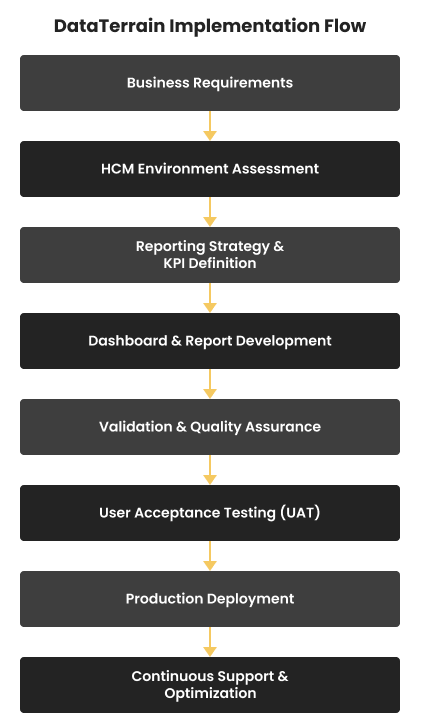
Figure 1. DataTerrain's Implementation Flow: eight steps from business requirements to continuous support.
DataTerrain Implementation Flow
- Business Requirements - collaborate with stakeholders to understand reporting objectives, business challenges, and the key workforce metrics the organization actually needs.
- HCM Environment Assessment - analyze existing HCM applications, data sources, integrations, and current reporting capabilities to identify gaps.
- Reporting Strategy & KPI Definition - standardize workforce KPIs, reporting requirements, dashboard layouts, and security models based on business priorities.
- Dashboard & Report Development - build interactive dashboards and operational reports aligned to industry best practices.
- Validation & Quality Assurance - test for data accuracy, KPI consistency, performance, and compliance.
- User Acceptance Testing (UAT) - have business users validate reports against operational expectations before go-live.
- Production Deployment - roll out the approved solution with minimal disruption to business operations.
- Continuous Support & Optimization - monitor, enhance, and tune performance as business needs evolve.
Turning Workforce Data Into Decisions
The hardest part of HCM solutions and real-time reports usually isn't the dashboards themselves. It's making sure workforce KPIs are defined consistently across every module before the first report gets built, then following a structured path from requirements through to production support.
DataTerrain has built and modernized HCM reporting environments for enterprise clients across payroll, recruitment, compliance, and workforce analytics, using the structured assessment-to-deployment approach described above. Visit the DataTerrain homepage to see the full range of services.
Talk to DataTerrain about your HCM reporting project.